power Filed Updated 32 min WR-FCT-009 ERASED thread
ROBESON
A school named for a man federal agencies worked to erase, approved for closure by a Board of Education vote.
Penn's own collaborative history records the university's "heavy hand in Unit 3 planning." Before the 2026 vote to close a school named for Paul Robeson, a state representative named Penn.
Every new file, the day it is filed.
On April 30, 2026, the Philadelphia Board of Education voted on a three-billion-dollar facilities plan. Seventeen schools would be closed. One of them was Paul Robeson High School for Human Services, in University City, a few blocks west of Penn’s campus. Before the vote, Councilmember Jamie Gauthier and six other lawmakers sent the Board a letter. Closing Robeson after promising to preserve the building, the letter said, would make the Board “complicit in the displacement that this community has been suffering since the razing of the Black Bottom.” In an April 20 social media post, State Representative Rick Krajewski, who also signed the letter, had already named an institution. He named the University of Pennsylvania.
Two facts sat inside that day. The first is that a state representative wrote that the University of Pennsylvania “has driven intense gentrification and displaced thousands of working-class Black families for decades.” The second is that the school the Board voted to close is named for a man federal agencies worked to erase from public memory in his lifetime.
The phrase that mattered on April 30, 2026 was not a metaphor. It was a citation. “The razing of the Black Bottom” names an event in this same part of West Philadelphia, decades earlier: the clearance of Unit 3, an urban renewal zone Penn’s collaborative history calls “roughly coterminous with the Black Bottom.” When the lawmakers put it in the letter, they set the closure beside the clearance, in writing, before a vote that had not yet happened.
Krajewski named the actor. Not “developers.” Not “the market.” Not “outside forces.” He named the University of Pennsylvania: by institution, by record, by decades of behavior. Penn, he said, “has driven intense gentrification and displaced thousands of working-class Black families for decades.” The school in question stands a few blocks west of Penn’s campus.
PHILADELPHIA BOARD OF EDUCATION
Facilities plan · $3 billion · The board resolution calls it a “living plan”
Schools designated for closure: 17 · Including: Paul Robeson High School for Human Services · School-code hearings required before any closing
[ A six-three majority. A lawmakers’ letter. A name from the clearance of Unit 3. ]
“Black Bottom” is not only a Detroit place name. It names at least two separate Black neighborhoods that institutional actors cleared, one in Detroit and one in West Philadelphia. CLEARANCE documented the Detroit version: a freeway, public infrastructure, eminent domain, and a 2023 city memo recording that officials condemned the homes of 7,897 people, and that ninety-two percent of those displaced were renters who received no compensation. The instrument was the state. The cover language was urban renewal.
The Philadelphia version did not need a freeway. It had a university-led consortium and a public Redevelopment Authority. In 1959, the University of Pennsylvania (together with Drexel, the Philadelphia College of Pharmacy and Science, Presbyterian Hospital, and the Osteopathic Medical School) formed the West Philadelphia Corporation. Penn was the majority shareholder. The Redevelopment Authority, in the words of Penn’s collaborative history, “acted in the interests of the West Philadelphia Corporation (WPC) and the School District of Philadelphia.” The same history says: “Archival research shows Penn’s dominance in the WPC and its heavy hand in Unit 3 planning.” Unit 3, the urban-renewal zone planned around the future University City Science Center, was condemned in 1966. In 1967 and 1968, Redevelopment Authority bulldozers leveled the blocks in the Market Street corridor. Penn’s West Philadelphia Collaborative History records that Unit 3 displaced 2,653 residents, approximately seventy-eight percent of them African American. Broader estimates of Black Bottom displacement, by various sources, run from 4,496 to 15,000.
from Unit 3 alone
were African American
formed · Penn majority shareholder
Market Street corridor leveled 1967 and 1968
Two clearances. Same name. Both ran through the state: Detroit’s through urban renewal and a freeway, Philadelphia’s through a public Redevelopment Authority that condemned Unit 3 by eminent domain in the interests of a university-led consortium.
To understand why the Robeson closure is not a routine schools story, look at what the building does in the neighborhood that survived the clearance. Gauthier and the other lawmakers wrote, in the letter: Robeson is “more than a school — it’s one of the few remaining institutional footholds for the Black community in University City.” A foothold is a load-bearing word. It means: this building is what keeps the post-clearance community visible to the civic record. Close the foothold and the community does not vanish. The community stops being visible to the institutions that issue the contracts and the permits and the future plans.
The decision was the paper: a six-to-three vote on a facilities plan that the board resolution calls a “living plan.” The Pennsylvania school code requires hearings before any school can close. On April 12, 34th Street Magazine reported that Robeson would merge with Motivation High School, “after which its building will be demolished.” Before the vote, The Inquirer reported that Superintendent Tony B. Watlington Sr. wanted the site to “remain in district hands for future use for community-directed science, technology, engineering, and math purposes,” and The Daily Pennsylvanian reported that the district would “seek community input on repurposing the Robeson site.” As of July 28, 2026, the district planned to begin the closures in the 2027-28 school year, and a City Council member was still weighing legal action.
LETTER FROM SEVEN LAWMAKERS
”To the local community, Paul Robeson is more than a school — it’s one of the few remaining institutional footholds for the Black community in University City."
"Voting to close Robeson after promising to preserve the building and increasing your facilities investment in the surrounding community by $120 million would make the Board complicit in the displacement that this community has been suffering since the razing of the Black Bottom.”
[ Co-signed letter · Inquirer reporting · April 30, 2026 ]
University City High School, which the West Philadelphia Corporation planned as a science-and-technology high school and the School District built on cleared Black Bottom land, operated from 1972 to 2013.
In a Penn Today announcement of November 17, 2020, Penn pledged a one-hundred-million-dollar contribution to the School District of Philadelphia (ten million dollars a year for ten years) to remediate asbestos and lead in school buildings. The university described the pledge as the largest private contribution in the District’s history.
The lawmakers’ letter says the Board had promised to preserve the Robeson building and had increased its facilities investment in the surrounding community by one hundred and twenty million dollars.
In 1959 the instrument was a public Authority acting in the interests of the West Philadelphia Corporation, in which the university was majority shareholder, and the School District of Philadelphia. The Corporation was restructured in 1983 as the West Philadelphia Partnership. The university is still here, and in 2026 a state representative named it.
To understand what is being closed in 2026, it is necessary to remember what was done to Paul Robeson the man. In 1950 the United States State Department demanded his passport, then cancelled it. In the account of the Provisional Committee to Restore Paul Robeson’s Passport, formed to win it back, two State Department agents “demanded that he turn in his lawfully held passport” on July 28, and on August 4 the department “announced to the press that it had cancelled” it. Federal district and appeals courts upheld the restrictions through the decade. He could not travel to Canada or the West Indies or Mexico, even where no passport was required. Concert halls, stages, radio and television were closed to him. According to the Zinn Education Project, newsreel footage of him was destroyed and recordings were erased. He was, in the parlance of the time, “contained.”
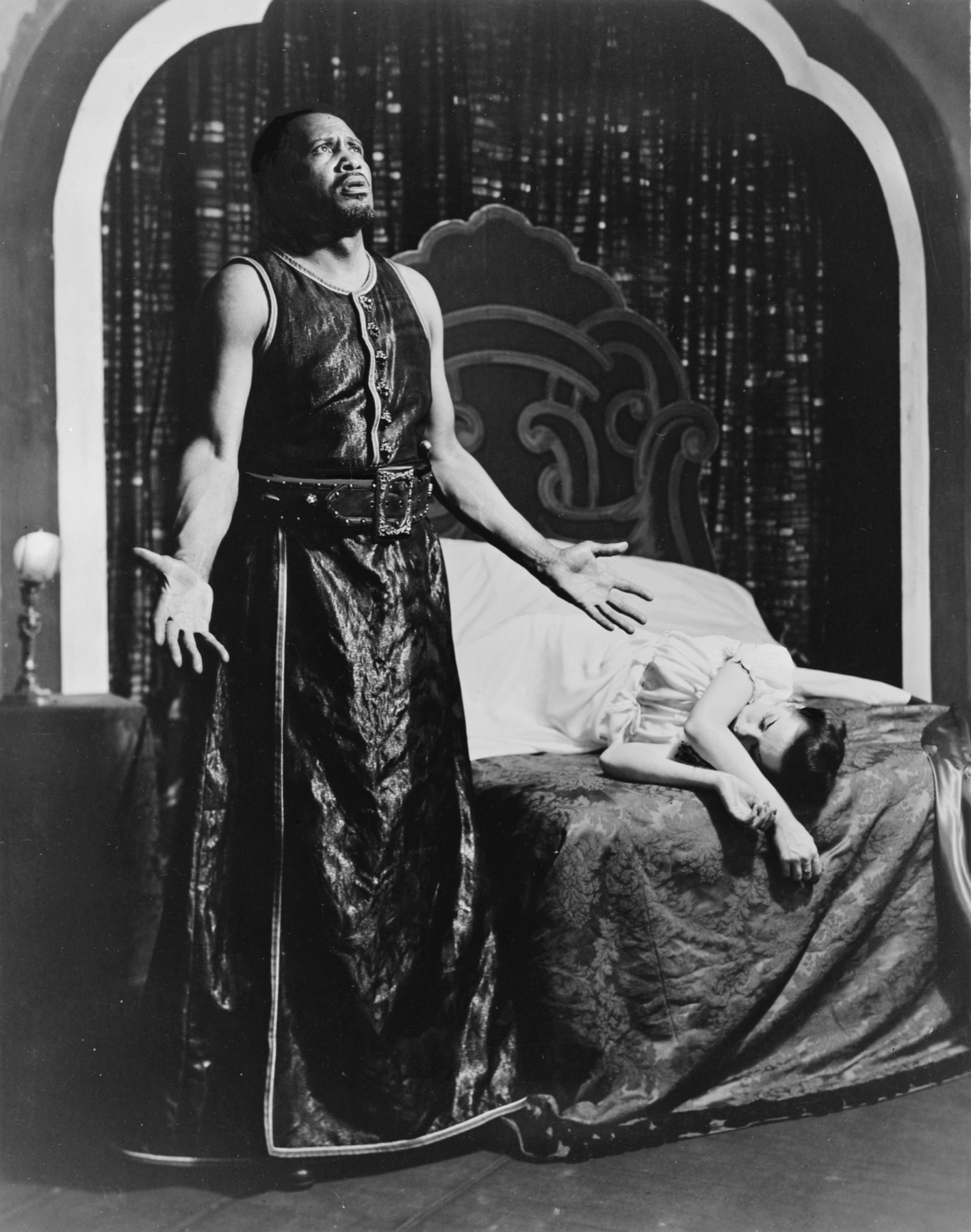
Paul Robeson as Othello, with Uta Hagen as Desdemona. Theatre Guild production, Broadway, 1943–44. Library of Congress, Prints & Photographs Division, Farm Security Administration/Office of War Information Black-and-White Negatives, LC-USW331-054945-ZC.
On June 12, 1956, the House Committee on Un-American Activities called him to testify. He invoked the Fifth Amendment. He told the Committee, on the record, that his father was a slave and that his people “died to build this country.” He told its members: “…you are the un-Americans and you ought to be ashamed of yourselves.” The State Department restored his passport in 1958, after the Supreme Court’s ruling in Kent v. Dulles. The damage was already in the record. He had been removed from public memory by what Penn’s collaborative history calls “a deliberate and largely successful campaign by federal agencies, mainstream media, and spiteful critics to efface the public’s memory of his exploits.”
He spent the last decade of his life, from 1966 until his death in 1976, in West Philadelphia, largely in the care of his sister at her house on Walnut Street. His public life had been erased by paper. The condemnation of Unit 3, between 34th and 40th Streets, began the same year. He died at West Philadelphia’s Presbyterian Hospital on January 23, 1976.
”…you are the un-Americans and you ought to be ashamed of yourselves.”
Paul Robeson · House Un-American Activities Committee · June 12, 1956
To close the school named for him, in the city where he spent his last decade, is not symbolic damage. It is structural damage to the public record. A name on a building is a load-bearing object. It carries the record of a person federal agencies, mainstream media and critics worked to efface from public memory.
This casefile’s argument is that the civic vocabulary has words for a for-profit landlord that displaces a community, for a developer and for a real-estate trust, and no word for a non-profit university that a state representative says “has driven intense gentrification and displaced thousands of working-class Black families for decades.”
The casefile argues that until the noun exists, the actor cannot be argued with, and that the Robeson closure is where the noun becomes urgent.
On the table
The civic vocabulary is the missing instrument. WR’s editorial proposal, advanced here as analysis and not yet docketed, is that the actor described in this casefile be named, in language that travels, anchor-extraction institution. Not a slogan. A noun.
Philadelphia Keepers: bring the receipts. The April 30 transcript. The Board’s facilities plan. The historical Black Bottom maps. The Robeson FBI file. If it is anchored, we docket it. The Archive is how we stay un-erasable.
Correction
Corrected 2026-10-01. This casefile published on June 24, 2026. A reading of the whole casefile against its primaries found seven errors, each named below in bold, rather than quietly repaired. The casefile’s proposal, a noun for the institution a state representative named, remains, offered as analysis. Several of the facts it stood on did not, and its argument is now narrowed to what the record in this file supports.
The Black Bottom was called a noun from another city. The casefile said: “The razing of the Black Bottom” is the working name of an event from another city, another set of bulldozers, decades earlier. It went on: “When Gauthier put it in the letter, she was lifting a noun out of one clearance and placing it on top of another, into the record, in real time, against a vote that had not yet happened.” It also said: “‘Black Bottom’ is not a Detroit place name.” “It is a portable civic noun that has been used, for more than half a century, to describe at least two separate Black neighborhoods that institutional actors cleared.” “The phrase moves because the pattern moves.” The letter’s Black Bottom is West Philadelphia’s own: Penn’s collaborative history says the urban renewal zone called Unit 3 “was roughly coterminous with the Black Bottom.” The passage now reads: “‘The razing of the Black Bottom’ names an event in this same part of West Philadelphia, decades earlier: the clearance of Unit 3, an urban renewal zone Penn’s collaborative history calls ‘roughly coterminous with the Black Bottom.’” “When the lawmakers put it in the letter, they set the closure beside the clearance, in writing, before a vote that had not yet happened.” “‘Black Bottom’ is not only a Detroit place name.” “It names at least two separate Black neighborhoods that institutional actors cleared, one in Detroit and one in West Philadelphia.”
Places were moved. The casefile said: “One of them was Paul Robeson High School for Human Services, on Ludlow Street, in the West Philadelphia neighborhood once called the Black Bottom.” “The school in question sits inside Penn’s campus footprint.” “The school the Board voted to close on April 30, 2026 sits on the same redevelopment perimeter.” 34th Street Magazine reported on April 12, 2026 that Robeson “stands only a few blocks west of Penn’s campus,” and Penn’s collaborative history places Unit 3 “between 34th & 40th streets.” Those lines now read: “One of them was Paul Robeson High School for Human Services, in University City, a few blocks west of Penn’s campus.” “The school in question stands a few blocks west of Penn’s campus.” The third is cut. Of Robeson’s last years, the casefile said: “He spent the last decade of his life, from 1966 until his death in 1976, at 4949 Walnut Street, in West Philadelphia.” “The neighborhood he retreated to was being cleared by the same instrument.” “The condemnation of Unit 3 began the same year.” “The campus footprint the West Philadelphia Corporation was clearing was, in those years, expanding around the block where he lived.” “He died there.” Penn’s collaborative history gives the house number as both 4951 and 4949 Walnut Street, and none of the three pages of it in this file places it inside or beside Unit 3. The same history says he “died at West Philadelphia’s Presbyterian Hospital (today’s Penn–Presbyterian Medical Center), from complications of a stroke, on January 23, 1976.” The passage now reads: “He spent the last decade of his life, from 1966 until his death in 1976, in West Philadelphia, largely in the care of his sister at her house on Walnut Street.” “The condemnation of Unit 3, between 34th and 40th Streets, began the same year.” “He died at West Philadelphia’s Presbyterian Hospital on January 23, 1976.” The closing line “To close the school named for him, on the ground he died on, by the same kind of institutional vote that erased him the first time, is not symbolic damage.” now reads “To close the school named for him, in the city where he spent his last decade, is not symbolic damage.”
The instruments were described backward. The casefile said: “It had a university.” “The Corporation directed redevelopment through the city’s Redevelopment Authority.” “Same noun.” “Different instruments.” “Detroit used the state.” “Philadelphia used the university.” “The instruments matter, and their difference is the entire reason the Philadelphia case has gone unnamed.” “The state cleared with eminent domain, which is publicly visible and politically contested.” “The university cleared through a non-profit consortium that the public was taught to call an ‘anchor institution.’” “Less paper trail in the civic vocabulary.” In Penn’s collaborative history, Black Bottom residents “were displaced through eminent domain,” the public Redevelopment Authority condemned Unit 3 and leveled the blocks in its Market Street corridor, and it “acted in the interests of the West Philadelphia Corporation (WPC) and the School District of Philadelphia.” Those lines now read: “It had a university-led consortium and a public Redevelopment Authority.” “The Redevelopment Authority, in the words of Penn’s collaborative history, ‘acted in the interests of the West Philadelphia Corporation (WPC) and the School District of Philadelphia.’” “The same history says: ‘Archival research shows Penn’s dominance in the WPC and its heavy hand in Unit 3 planning.’” “Same name.” “Both ran through the state: Detroit’s through urban renewal and a freeway, Philadelphia’s through a public Redevelopment Authority that condemned Unit 3 by eminent domain in the interests of a university-led consortium.” The casefile also said: “The 1959 instrument was a non-profit consortium with the university as majority shareholder.” “The 2026 instrument is the same consortium, sixty-seven years older, with a far larger endowment, a public-relations arm, and a vocabulary the public does not yet have a counter-vocabulary for.” “The route is identical.” The Corporation was restructured in 1983 as the West Philadelphia Partnership, and no source in this file gives it a role in the 2026 vote. Those lines now read: “In 1959 the instrument was a public Authority acting in the interests of the West Philadelphia Corporation, in which the university was majority shareholder, and the School District of Philadelphia.” “The Corporation was restructured in 1983 as the West Philadelphia Partnership.” “The university is still here, and in 2026 a state representative named it.”
The letter’s claim was reported as the Board’s act. The casefile said: “The Board’s April 30 plan, separately, increased its facilities investment in the surrounding community by an additional one hundred and twenty million dollars.” “Gauthier’s letter named that number as a promise: the kind of number that, in the civic-language playbook, dresses a closure vote as its opposite.” “A hundred-twenty-million-dollar investment in the surrounding community, voted on the same day as the closure of one of that community’s last institutional footholds, is not a contradiction in the civic-language playbook.” “It is the playbook.” The only source for the figure is the lawmakers’ letter, which reads, as The Inquirer printed it before the vote: “Voting to close Robeson after promising to preserve the building and increasing your facilities investment in the surrounding community by $120 million would make the Board complicit in the displacement that this community has been suffering since the razing of the Black Bottom.” The promise the letter names is to preserve the building, and the increase is the letter’s description, not a Board record in this file. The passage now reads: “The lawmakers’ letter says the Board had promised to preserve the Robeson building and had increased its facilities investment in the surrounding community by one hundred and twenty million dollars.” The rest is cut. The second document box printed the letter with an ellipsis: “Voting to close Robeson … would make the Board complicit in the displacement that this community has been suffering since the razing of the Black Bottom.” It now prints the sentence in full.
A vote that erased him, and a closure stated as done. The casefile said: “The second is that the school being closed is named for a man whose own name was stripped from circulation in his lifetime, by the same kind of institutional vote that is now removing his name from the building.” “He had been removed from public memory by paper and by silence, by the kind of institutional vote that does not announce itself as a vote.” “It carries the record of a person the institutions tried, and partly succeeded, in removing.” “To remove the name a second time (by paper, by vote, by demolition schedule) is to complete a sentence that began in 1950.” “The name on the building is a record of a person the institutions already erased once.” “The vote on April 30, 2026 was the second erasure, signed before the building was touched.” “The instrument was an institutional vote.” “The instrument was always an institutional vote.” “The only thing that changed was who got to call themselves the neighbor.” His passport was suspended by the State Department, the restrictions were upheld by the courts, and the hearing was a hearing; none was a vote. Penn’s collaborative history names those who worked to erase him: “a deliberate and largely successful campaign by federal agencies, mainstream media, and spiteful critics to efface the public’s memory of his exploits.” No source in this file says his name is being removed from the building. Those lines now read: “The second is that the school the Board voted to close is named for a man federal agencies worked to erase from public memory in his lifetime.” “He had been removed from public memory by what Penn’s collaborative history calls ‘a deliberate and largely successful campaign by federal agencies, mainstream media, and spiteful critics to efface the public’s memory of his exploits.’” “It carries the record of a person federal agencies, mainstream media and critics worked to efface from public memory.” “The name on the building is a record of a person federal agencies worked to erase from public memory.” “The vote on April 30, 2026 approved closing the school that carries it.” The casefile also said: “The visible event will be the demolition.” “The actual decision was the paper.” “A six-to-three vote on a facilities plan is the route map.” “The bulldozer, when it arrives, will only be following the line already drawn.” “By the time the building comes down, the question will already be closed.” The plan is not final, and the record on the building is mixed. The passage now reads: “The decision was the paper: a six-to-three vote on a facilities plan that the board resolution calls a ‘living plan.’” “The Pennsylvania school code requires hearings before any school can close.” “On April 12, 34th Street Magazine reported that Robeson would merge with Motivation High School, ‘after which its building will be demolished.’” “Before the vote, The Inquirer reported that Superintendent Tony B. Watlington Sr. wanted the site to ‘remain in district hands for future use for community-directed science, technology, engineering, and math purposes,’ and The Daily Pennsylvanian reported that the district would ‘seek community input on repurposing the Robeson site.’” “As of July 28, 2026, the district planned to begin the closures in the 2027-28 school year, and a City Council member was still weighing legal action.” The Inquirer’s report was published at 5:01 a.m. on April 30 and the DP’s on April 29, both before the vote.
A quotation that does not match its record, and words no source carries. The casefile quoted Robeson: “He said: ‘You are the un-Americans, and you ought to be ashamed of yourselves.’” The quotation box printed “You are the un-Americans, and you ought to be ashamed of yourselves.” The printed hearing record, Investigation of the Unauthorized Use of United States Passports, Part 3, June 12, 1956, reads “you are the un-Americans and you ought to be ashamed of yourselves,” without the comma, inside a longer sentence. The body, the box and the docket now print it the same way, with a leading ellipsis: “He told its members: ‘…you are the un-Americans and you ought to be ashamed of yourselves.’” The box reads “…you are the un-Americans and you ought to be ashamed of yourselves.” The casefile also put words in quotation marks that no document in this file carries. It said: “The University of Pennsylvania has a vocabulary for what it does in West Philadelphia.” and listed “‘Anchor institution.’ ‘Neighbor.’ ‘Partner.’ ‘Engine of opportunity.’” No document in this file attributes any of the four to Penn as its own name for itself. Of Robeson, it said: “The blacklist did not require a charge.” “It required a vocabulary.” “He was not ‘imprisoned.’” “He was ‘contained.’” “He was not ‘censored.’” “He was ‘unbookable.’” Those lines are cut. Penn’s collaborative history supports one of the words, and the passage now reads: “He was, in the parlance of the time, ‘contained.’”
The argument outran its record. The casefile’s thesis rested on claims no source in this file supports. Its excerpt read: “Penn isn’t the exception to the Black Bottom logic. Penn is the upgrade, and the city does not yet have a word for what that makes the university.” Its hook read: “When the displacement actor is a tax-exempt non-profit, the city loses the language to name what is happening.” Its opening said: “Two facts sat inside that morning that the public has not yet been given a single word for.” “The first is that the most efficient private displacement actor in West Philadelphia is a tax-exempt non-profit.” Section 04 was titled “04 / The anchor that extracts.” It said: “Anchor institution is a piece of language that was engineered so that extraction would not be legible as extraction.” “A for-profit landlord assembling that kind of footprint, with that kind of tax position, with that kind of leverage over local zoning and policing and schools, would be called a real-estate empire.” “A non-profit university with the same footprint and the same leverage is called an anchor.” “The civic vocabulary did not develop this asymmetry by accident.” “The institution that did the clearing also did the naming, and the public was taught to call it anchoring before anyone had a word for what the anchoring cost.” “This is why Penn is not the exception to the Black Bottom logic.” “Penn is the upgrade.” A display card printed “A N C H O R” over “A word that sounds civic.” “The mooring is the institution.” “The drift is the community.” Section 06 said: “The civic vocabulary has a word for a for-profit landlord that displaces a community.” “It has a word for a developer.” “It has a word for a real-estate trust.” “It does not have a word for a tax-exempt, non-profit, multi-billion-dollar university that is the most efficient private displacement actor in its city.” “That gap is the instrument.” “Until the noun exists, the actor cannot be argued with.” “The Robeson closure is the place where the noun becomes urgent.” “Until the actor can be argued with, the route map will keep being drawn by the institutions that already control the language.” The closing proposal ended: “A word that does for the 2026 university what ‘redlining’ did for the 1938 underwriting manual: makes the mechanism legible enough to litigate, legislate, and refuse.” No source in this file ranks displacement actors, records who coined “anchor institution” or why, gives Penn’s tax position, or treats the 1938 manual. What the file does support is narrower: Penn’s collaborative history records “Penn’s dominance in the WPC and its heavy hand in Unit 3 planning,” and in April 2026 a state representative named Penn for decades of displacement. The excerpt now reads: “Penn’s own collaborative history records the university’s ‘heavy hand in Unit 3 planning.’ Before the 2026 vote to close a school named for Paul Robeson, a state representative named Penn.” The hook now reads: “A state representative named Penn for decades of displacement. Penn’s own history records its hand in Unit 3 planning.” The opening now reads: “Two facts sat inside that day.” “The first is that a state representative wrote that the University of Pennsylvania ‘has driven intense gentrification and displaced thousands of working-class Black families for decades.’” Section 04 is now titled “04 / The record.” The card and the paragraphs quoted above are cut. Section 06 now states its argument as the casefile’s own: “This casefile’s argument is that the civic vocabulary has words for a for-profit landlord that displaces a community, for a developer and for a real-estate trust, and no word for a non-profit university that a state representative says ‘has driven intense gentrification and displaced thousands of working-class Black families for decades.’” “The casefile argues that until the noun exists, the actor cannot be argued with, and that the Robeson closure is where the noun becomes urgent.” The other lines are cut.
Other changes made at the same time, each quoted as it was and as it now reads:
- The subtitle “A school named for an erased man, closed by the kind of institutional vote that erased him.” now reads “A school named for a man federal agencies worked to erase, approved for closure by a Board of Education vote.”
- “On the morning of April 30, 2026, the Philadelphia Board of Education sat down to vote on a three-billion-dollar facilities plan.” now reads “On April 30, 2026, the Philadelphia Board of Education voted on a three-billion-dollar facilities plan.” The meeting was scheduled for 4 p.m.
- “Before the vote, Councilmember Jamie Gauthier, co-signing with other lawmakers, sent the Board a letter.” now reads “Before the vote, Councilmember Jamie Gauthier and six other lawmakers sent the Board a letter.” “The letter said, in plain language, that to close Robeson would be to make the Board ‘complicit in the displacement that this community has been suffering since the razing of the Black Bottom.’” now reads “Closing Robeson after promising to preserve the building, the letter said, would make the Board ‘complicit in the displacement that this community has been suffering since the razing of the Black Bottom.’”
- “In an April 20 public statement, State Representative Rick Krajewski had already named the institution responsible for that displacement.” now reads “In an April 20 social media post, State Representative Rick Krajewski, who also signed the letter, had already named an institution.” The letter’s signers are named in The Inquirer; Gauthier herself named “government and institutions,” not Penn.
- “Krajewski did the second thing officials almost never do.” “He named the actor.” now reads “Krajewski named the actor.” “Anyone who knew the campus knew exactly which building Krajewski meant.” is cut. His post names no building.
- In the first document box, the status “APPROVED · 17 SCHOOLS CLOSED” now reads “APPROVED · 17 SCHOOLS SLATED TO CLOSE”; “Facilities Modernization Plan · Total: $3,000,000,000” now reads “Facilities plan · $3 billion · The board resolution calls it a ‘living plan’”; “Schools designated for closure: 17 · Including: Paul Robeson High School for Human Services” now reads “Schools designated for closure: 17 · Including: Paul Robeson High School for Human Services · School-code hearings required before any closing”; and the footer ”[ A six-three majority. A letter on the record. A noun that crossed a state line and entered the minutes. ]” now reads ”[ A six-three majority. A lawmakers’ letter. A name from the clearance of Unit 3. ]”
- The second document box’s title “OFFICE OF COUNCILMEMBER JAMIE GAUTHIER” now reads “LETTER FROM SEVEN LAWMAKERS,” its docket line “LETTER TO THE BOARD OF EDUCATION” now reads “TO THE BOARD OF EDUCATION,” and its status “ENTERED INTO RECORD · APRIL 30, 2026” now reads “REPORTED BY THE INQUIRER · APRIL 30, 2026.” It now prints “Voting to close Robeson after promising to preserve the building and increasing your facilities investment in the surrounding community by $120 million would make the Board complicit in the displacement that this community has been suffering since the razing of the Black Bottom.”
- “CLEARANCE documented the Detroit version: a freeway, public infrastructure, eminent domain, 7,897 residents displaced by I-375, ninety-two percent of them renters who received nothing.” now reads “CLEARANCE documented the Detroit version: a freeway, public infrastructure, eminent domain, and a 2023 city memo recording that officials condemned the homes of 7,897 people, and that ninety-two percent of those displaced were renters who received no compensation.” That is how CLEARANCE now gives the figures.
- “In 1959, the University of Pennsylvania (together with Drexel, the Philadelphia College of Pharmacy and Science, and Presbyterian Hospital) formed the West Philadelphia Corporation.” now reads “In 1959, the University of Pennsylvania (together with Drexel, the Philadelphia College of Pharmacy and Science, Presbyterian Hospital, and the Osteopathic Medical School) formed the West Philadelphia Corporation.”
- “By 1968 the bulldozers were finished.” now reads “In 1967 and 1968, Redevelopment Authority bulldozers leveled the blocks in the Market Street corridor.” Penn’s collaborative history places the leveling there and does not say all of Unit 3 was leveled in those years.
- “The Corporation’s own collaborative history records that Unit 3 displaced 2,653 residents, approximately seventy-eight percent of them African American.” now reads “Penn’s West Philadelphia Collaborative History records that Unit 3 displaced 2,653 residents, approximately seventy-eight percent of them African American.” The history is a project of Penn’s Graduate School of Education, not of the 1959 Corporation.
- “Broader estimates of Black Bottom displacement run from 4,496 to more than 15,000.” now reads “Broader estimates of Black Bottom displacement, by various sources, run from 4,496 to 15,000.”
- The figure panel’s “Black Bottom condemned, razed, replaced” now reads “Unit 3 condemned 1966, Market Street corridor leveled 1967 and 1968”
- “To understand why the Robeson closure is not a routine schools story, look at what the building does in the neighborhood that survived the first clearance.” now reads “To understand why the Robeson closure is not a routine schools story, look at what the building does in the neighborhood that survived the clearance.”
- “Gauthier wrote, on the record: Robeson is ‘more than a school — it’s one of the few remaining institutional footholds for the Black community in University City.’” now reads “Gauthier and the other lawmakers wrote, in the letter: Robeson is ‘more than a school — it’s one of the few remaining institutional footholds for the Black community in University City.’”
- “There is a second piece of the foothold the public has not yet been told to read.” is cut. No source in this file places Robeson High on cleared ground. “University City High School, the magnet built by the West Philadelphia Corporation on cleared Black Bottom land in 1972, closed in 2013.” now reads “University City High School, which the West Philadelphia Corporation planned as a science-and-technology high school and the School District built on cleared Black Bottom land, operated from 1972 to 2013.” “The 2026 vote did not begin a displacement on this ground.” “It continued one.” is cut.
- “In a Penn Today announcement, Penn pledged a one-hundred-million-dollar contribution to the School District of Philadelphia (ten million dollars a year for ten years) to remove asbestos and lead from school buildings.” now reads “In a Penn Today announcement of November 17, 2020, Penn pledged a one-hundred-million-dollar contribution to the School District of Philadelphia (ten million dollars a year for ten years) to remediate asbestos and lead in school buildings.” “It was, by Penn’s own framing, a flagship act of anchoring.” is cut.
- “On August 4, 1950, the United States State Department revoked his passport.” now reads “In 1950, the United States State Department suspended his passport.” No source in this file gives the day. “Federal courts upheld the revocation throughout the decade.” now reads “Federal district and appeals courts upheld the restrictions through the decade.” “Concert bookings were canceled.” “Recordings were pulled.” now reads “Concert halls, stages, radio and television were closed to him.” “Recordings were erased.”
- “He told the Committee, on the record, that his father had been a slave and that his people had built the country.” now reads “He told the Committee, on the record, that his father was a slave and that his people ‘died to build this country.’” The record has “died to build.”
- “The recordings did not return.” “The bookings did not return.” “The career did not return.” is cut. Penn’s collaborative history records a sold-out concert at the Royal Albert Hall in the summer of 1958, after his passport was restored.
- The search description “on ground in West Philadelphia once called the Black Bottom” now reads “named for a man federal agencies worked to erase.”
- In the docket, the vote, letter, superintendent, Krajewski, consortium, high school, passport, hearing, residence, pledge and $120 million items now match the text above. Newspaper items now carry Confidence B, the tier of their source. New items record 34th Street Magazine’s “stands only a few blocks west of Penn’s campus” and “will merge with Motivation High School, after which its building will be demolished”; Penn’s collaborative history’s “roughly coterminous with the Black Bottom” and “Archival research shows Penn’s dominance in the WPC and its heavy hand in Unit 3 planning”; the board resolution’s “living plan” and the school-code hearings; the hearing record’s “my father was a slave, and my people died to build this country”; the Redevelopment Authority’s leveling of “the blocks in the Market Street corridor” in 1967 and 1968; the superintendent’s wish that the site “remain in district hands for future use for community-directed science, technology, engineering, and math purposes”; the Supreme Court ruling “in a case that did not involve him directly”; and the closures’ 2027-28 start with the Council member’s consideration of legal action.
Sources: Philadelphia Inquirer, April 30, 2026, pre-vote and post-vote reports; The Daily Pennsylvanian, April 29, 2026; 34th Street Magazine, April 12, 2026; Chalkbeat Philadelphia, July 28, 2026; West Philadelphia Collaborative History (Penn GSE), “The University City Science Center and the Black Bottom,” “Paul Robeson, Part III: Freedom’s Price” and “Paul Robeson, Part IV: Erasure from Historical Memory”; Penn Today, November 17, 2020; Zinn Education Project; U.S. House Committee on Un-American Activities, Investigation of the Unauthorized Use of United States Passports, Part 3 (1956), printed hearing; Wikipedia, “Black Bottom, Philadelphia.” Read on October 1, 2026.
Corrected 2026-10-03. This casefile published on June 24, 2026. One sentence used a softer verb than the record of the time and left a gap that a document from about 1951 fills. It is named here rather than quietly repaired.
A softer verb than the record. The casefile said: “In 1950, the United States State Department suspended his passport.” The 2026-10-01 correction set that sentence from Penn’s collaborative history, which uses “suspended,” and noted that no source in this file gave the day. A record from about 1951 does. The Provisional Committee to Restore Paul Robeson’s Passport, formed to win the passport back, writes that on July 28, 1950, two State Department agents “demanded that he turn in his lawfully held passport,” and that on August 4 the department “announced to the press that it had cancelled Paul Robeson’s passport.” As the committee reports it, the department’s announcement said cancelled, not suspended. The sentence now reads: “In 1950 the United States State Department demanded his passport, then cancelled it. In the account of the Provisional Committee to Restore Paul Robeson’s Passport, formed to win it back, two State Department agents ‘demanded that he turn in his lawfully held passport’ on July 28, and on August 4 the department ‘announced to the press that it had cancelled’ it.” The committee’s record is added to the sources and the docket.
Source: Provisional Committee to Restore Paul Robeson’s Passport, “The Case of Paul Robeson’s Passport,” a fact sheet, ca. 1951, transcript published by The New York Public Library. Read on October 3, 2026.
Corrected 2026-10-18. This casefile published on June 24, 2026. Two sentences stated as fact what rests on a single secondary source. They are named here rather than quietly repaired.
A claim without its source. The casefile said: “Recordings were erased. Newsreel footage was destroyed.” The only source in this file for those sentences is the Zinn Education Project, which writes that “Newsreel footage of him was destroyed, recordings were erased and there was a clear effort in the media to avoid any mention of his name.” The passage now names it: “According to the Zinn Education Project, newsreel footage of him was destroyed and recordings were erased.”
Source: Zinn Education Project, “Aug. 16, 1955: Paul Robeson Lost Court Appeal” (This Day in History), zinnedproject.org, Internet Archive snapshot of September 27, 2026. Read on October 18, 2026.
DOCKET
- On April 30, 2026 the Philadelphia Board of Education approved, by a 6-3 vote, a $3 billion facilities plan that would close 17 schools, including Paul Robeson High School. The board resolution calls it a 'living plan,' and the Pennsylvania school code requires hearings before any school can close. Philadelphia Inquirer, post-vote report · April 30, 2026 · Confidence: B
- Councilmember Jamie Gauthier and six other lawmakers wrote to the Board, in a letter obtained by The Inquirer: 'Voting to close Robeson after promising to preserve the building and increasing your facilities investment in the surrounding community by $120 million would make the Board complicit in the displacement that this community has been suffering since the razing of the Black Bottom.' The same report says Superintendent Tony B. Watlington Sr. wants the Robeson site to 'remain in district hands for future use for community-directed science, technology, engineering, and math purposes.' Philadelphia Inquirer, pre-vote report · April 30, 2026 · Confidence: B
- State Representative Rick Krajewski wrote in an April 20 social media post that the University of Pennsylvania 'has driven intense gentrification and displaced thousands of working-class Black families for decades.' In an April 29 report on the revised plan, the DP wrote that the district will 'seek community input on repurposing the Robeson site.' The Daily Pennsylvanian · April 29, 2026 · Confidence: B
- The West Philadelphia Corporation (a consortium with the University of Pennsylvania as majority shareholder, joined by Drexel, Philadelphia College of Pharmacy and Science, Presbyterian Hospital, and the Osteopathic Medical School) was formed in 1959. In clearing Unit 3, which 'was roughly coterminous with the Black Bottom,' the Redevelopment Authority 'acted in the interests of the West Philadelphia Corporation (WPC) and the School District of Philadelphia.' 'Archival research shows Penn's dominance in the WPC and its heavy hand in Unit 3 planning.' West Philadelphia Collaborative History (Penn GSE) · Confidence: A
- Robeson High School 'stands only a few blocks west of Penn's campus'; on April 12 the magazine reported that it 'will merge with Motivation High School, after which its building will be demolished.' 34th Street Magazine · April 12, 2026 · Confidence: B
- Unit 3 of that redevelopment displaced 2,653 residents, approximately 78% of whom were African American. The Philadelphia Redevelopment Authority condemned the properties in 1966; in 1967 and 1968 its bulldozers leveled the blocks in the Market Street corridor. West Philadelphia Collaborative History (Penn GSE) · Confidence: A
- University City High School was planned by the West Philadelphia Corporation 'as a high school of science & technology to be affiliated with the Science Center' and built by the School District of Philadelphia on cleared Black Bottom land. It operated from 1972 to 2013. West Philadelphia Collaborative History (Penn GSE) · Confidence: A
- The State Department demanded and then cancelled Paul Robeson's U.S. passport in 1950, in the account of the Provisional Committee to Restore Paul Robeson's Passport, and forbade him to travel even to Canada, the West Indies or Mexico; he was, 'in the parlance of the time, "contained."' Federal district and appeals courts upheld the restrictions through the 1950s. In 1958 a 5-4 Supreme Court ruling 'in a case that did not involve him directly,' Kent v. Dulles, 357 U.S. 116, ended his eight-year passport ordeal. West Philadelphia Collaborative History (Penn GSE) · Zinn Education Project · Confidence: A
- On June 12, 1956 Robeson testified before a subcommittee of the House Committee on Un-American Activities and said: '…you are the un-Americans and you ought to be ashamed of yourselves,' and 'my father was a slave, and my people died to build this country.' U.S. Congress, HUAC, Investigation of the Unauthorized Use of United States Passports, Part 3, 84th Cong., 2d Sess. (1956) · Confidence: A
- Robeson spent the last decade of his life (1966 to 1976) in West Philadelphia, largely in the care of his sister at her house on Walnut Street, and died at West Philadelphia's Presbyterian Hospital on January 23, 1976. Penn's collaborative history describes 'a deliberate and largely successful campaign by federal agencies, mainstream media, and spiteful critics to efface the public's memory of his exploits.' West Philadelphia Collaborative History (Penn GSE) · Confidence: A
- On November 17, 2020 the University of Pennsylvania pledged $100 million to the School District of Philadelphia ($10 million annually for ten years) for environmental remediation of asbestos and lead in school buildings. Penn Today · Confidence: A
- The lawmakers' letter says the Board had promised to preserve the Robeson building and had increased its facilities investment in the surrounding community by $120 million. Philadelphia Inquirer · April 30, 2026 · Confidence: B
- As of July 28, 2026 the district planned to close 17 schools beginning in the 2027-28 school year, and Councilmember Isaiah Thomas said he was still considering legal action. Chalkbeat Philadelphia · July 28, 2026 · Confidence: B
- Provisional Committee to Restore Paul Robeson's Passport, fact sheet (ca. 1951): on July 28, 1950, two State Department agents "demanded that he turn in his lawfully held passport"; on August 4, 1950, the department "announced to the press that it had cancelled Paul Robeson's passport." nypl.org · Confidence: B
How this file was made
Every claim in the docket traces to a public document.
Its clearance record shows these checks, in order:
Receipts. Canon. Copy edit. Voice. Line edit. Proofread. Approval.
The 17 sources · What we have corrected · WR-FCT-009 · 10.5281/zenodo.23115710
Cite this file
Word Reimagined, “ROBESON,” WR-FCT-009, https://doi.org/10.5281/zenodo.23115710.
The number is permanent. WR-FCT-009 names this file today and will name the same file in ten years. Add the date you retrieved it.
This file is also deposited with Zenodo, at CERN, under 10.5281/zenodo.23115710. That copy carries the essay whole, its docket and its source ledger, and it outlives this domain.
Trace record
Every claim in this file resolves to a source in the custody ledger.
- Philadelphia Inquirer, Negotiations continue 'around-the-clock' ahead of Thursday board vote on 17 Philly school closings, April 30, 2026
Kristen A. Graham. 'Negotiations continue "around-the-clock" ahead of Thursday board vote on 17 Philly school closings.' Philadelphia Inquirer, April 30, 2026, 5:01 a.m. ET.
article B
- The Daily Pennsylvanian, Penn-partnered high schools still set to close despite Philadelphia School District plan revisions, April 29, 2026
Alex Dash. 'Penn-partnered high schools still set to close despite Philadelphia School District plan revisions.' The Daily Pennsylvanian, April 29, 2026.
article B
- 34th Street Magazine, Closing Schools Closes Community, April 12, 2026
Jessica Tobes. 'Closing Schools Closes Community.' 34th Street Magazine, April 12, 2026.
article B
- Penn Collaborative History — The University City Science Center and the Black Bottom
West Philadelphia Collaborative History, University of Pennsylvania Graduate School of Education. 'The University City Science Center and the Black Bottom.'
archive A
- Black Bottom, Philadelphia — Wikipedia
Wikipedia. 'Black Bottom, Philadelphia.'
web D
- Penn Collaborative History — Paul Robeson, Part III: Freedom's Price
West Philadelphia Collaborative History, University of Pennsylvania Graduate School of Education. 'Paul Robeson, Part III: Freedom's Price.'
archive A
- The American Yawp Reader, Paul Robeson's Appearance Before the House Un-American Activities Committee (1956)
The American Yawp Reader, Chapter 25 (The Cold War). 'Paul Robeson's Appearance Before the House Un-American Activities Committee (1956).' Excerpts from the June 12, 1956 hearing.
archive B
- Penn Today — Penn Pledges $100 Million to the School District of Philadelphia
Penn Today. 'Penn pledges $100 million to the School District of Philadelphia.'
web A
- Zinn Education Project — Paul Robeson Passport Revocation, 1950
Zinn Education Project. 'Aug. 16, 1955: Paul Robeson Lost Court Appeal' / 'Paul Robeson Testifies Before HUAC.'
web B
- Detroit Historical Society, Black Bottom Neighborhood
Detroit Historical Society. 'Black Bottom Neighborhood.' Encyclopedia of Detroit.
web C
- City of Detroit I-375 Reconnecting Communities Impact Memo
City of Detroit. Impact of I-375 memorandum. September 2023.
archive A
- Kent v. Dulles, 357 U.S. 116 (1958)
Rockwell Kent and Walter Briehl, Petitioners, v. John Foster Dulles, Secretary of State, 357 U.S. 116 (1958). Argued April 10, 1958. Decided June 16, 1958. Majority opinion by Justice Douglas.
archive A
- The Case of Paul Robeson's Passport (Provisional Committee to Restore Paul Robeson's Passport, ca. 1951)
Provisional Committee to Restore Paul Robeson's Passport, 'The Case of Paul Robeson's Passport,' ca. 1951. Transcript published by The New York Public Library.
archive B
- Philadelphia Inquirer, Philadelphia School Board Votes to Close 17 Schools, April 30, 2026
Kristen A. Graham and Dana Munro. 'Philadelphia school board votes to close 17 schools.' Philadelphia Inquirer, April 30, 2026.
article B
- Penn Collaborative History, Paul Robeson, Part IV: Erasure from Historical Memory
West Philadelphia Collaborative History, University of Pennsylvania Graduate School of Education. 'Paul Robeson, Part IV: Erasure from Historical Memory.'
archive A
- HUAC, Investigation of the Unauthorized Use of United States Passports, Part 3, June 12 and 13, 1956
U.S. House of Representatives, Committee on Un-American Activities. Investigation of the Unauthorized Use of United States Passports, Part 3. Hearings, 84th Congress, 2d Session, June 12 and 13, 1956. Washington: Government Printing Office, 1956.
archive A
- Chalkbeat Philadelphia, Philadelphia City Council members say they will 'use every tool in our arsenal' to stop school closures, July 28, 2026
Rebecca Redelmeier. 'Philadelphia City Council members say they will "use every tool in our arsenal" to stop school closures.' Chalkbeat Philadelphia, July 28, 2026.
article B
Sources are graded A (primary) / B (secondary academic) / C (secondary journalism) / D (tertiary or contested). See the manifesto’s Evidence Standard for full criteria.
File custody
- File
- ROBESON
- Accession
- WR-FCT-009
- Thread
- ERASED
- Status
- published
- Published
- 2026-06-24
- Last updated
- 2026-10-18
- As of
- 2026-10-18
Support is welcome and never required. The door is open; it is not a request.