history Filed 02 · 28 7 min WR-FCT-001 ERASED thread
DENIED
Greenwood wasn't just burned. It was buried under denial.
The second fire of Black Wall Street.
Every new file, the day it is filed.
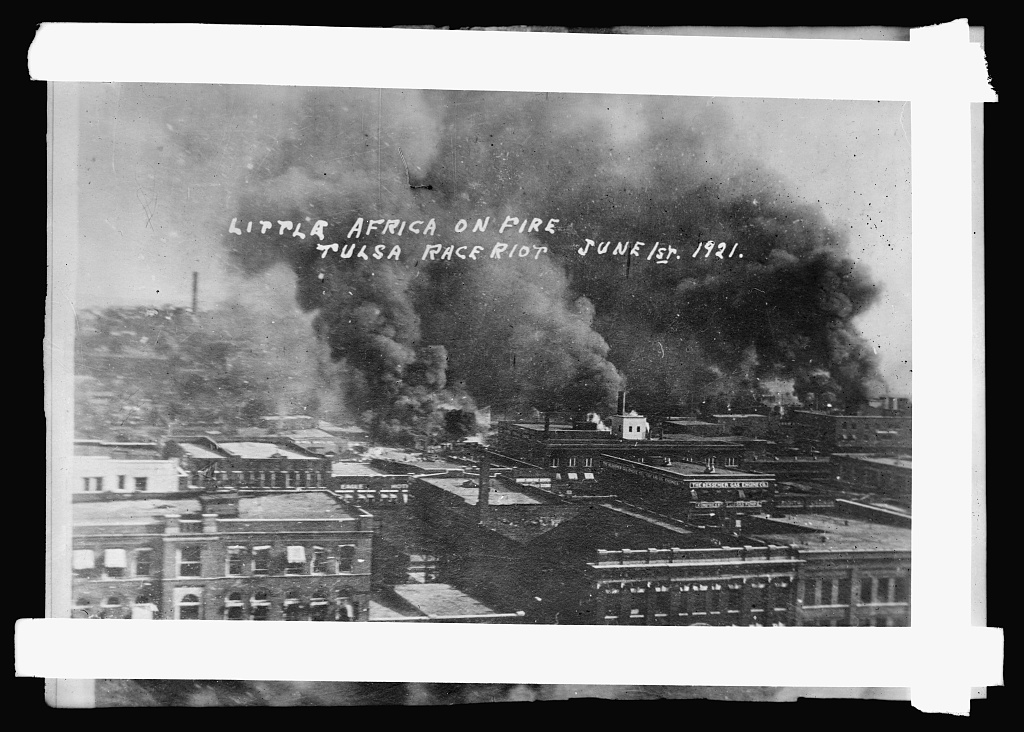
Greenwood was not just burned. Greenwood was processed. The most violent sound in America is not always a gunshot. Sometimes it is a stamp. DENIED. What happened in Tulsa was not a single event. It was a two-part mechanism. First was the burning. What followed like the reaper was bureaucracy. If we only tell the fire story, we miss the part that keeps repeating.
The fire makes headlines. Paperwork makes theft permanent.
Before we talk about destruction, we tell the truth about what existed. Greenwood was infrastructure. A working Black district with commerce, homes, churches, professionals, and the kind of economic circulation that turns a neighborhood into a statement. A place that proved something dangerous. We can build without permission. We can thrive even when the rules are written to starve us.
Prosperity changes posture. Options make you harder to manage. So when people ask “Why Tulsa?” the honest answer is simple. Because it worked.
In January 2025, the U.S. Department of Justice released a report on the Tulsa Race Massacre. It is not a nostalgia document. It reads like an indictment written a century late. The report says local police deputized hundreds of white residents and helped organize the forces that ravaged Greenwood. Those forces looted, burned, and destroyed 35 city blocks.
The Red Cross estimate: 1,256 houses burned. Another 215 looted. Businesses burned and looted too. That is not disorder. That is a system moving in formation. This is where the story usually stops. People sit in the ash like it is the ending. It is not the ending. The ash is the opening scene.
”The fire makes headlines. The paperwork makes theft permanent.”
— DENIED · Word Reimagined
After the flames, normal returned. Normal did not arrive with compassion. Normal arrived with forms. Deadlines. Burden of proof. Legal shields. The riot clause. The Oklahoma Commission report lays it out plainly. Homes and businesses were insured. The Black community filed more than $4 million in claims against the city and insurance companies. Insurance companies denied compensation. They cited the standard riot clause. Policy language became a trapdoor.
Homeowners challenged those denials. They lost. In 1926, the Oklahoma Supreme Court issued a ruling that precluded suits against insurance companies for massacre damages. That is the second fire. No smoke. No sirens. Just a door closing with a soft click.
Denial is how theft becomes permanent. Denial is how the story gets rewritten. If it was not compensated, maybe it was not real. If it was not repaired, maybe it was not valuable. If the claims were denied at scale, what were people supposed to rebuild with? Faith?
Greenwood did not vanish. Greenwood fought. The DOJ report includes one detail that reads like a photograph. B.C. Franklin and his colleagues set up a tent on Archer Street as a temporary law firm. A tent became an office. Paper became a weapon. They collected information to file lawsuits for recovery and to attack the fire ordinance. Tulsa imposed harsh new fire codes that priced residents out. A court later enjoined those provisions. Before the ordinance was invalidated, many people of Greenwood were arrested during early efforts to rebuild.
Rebuild happened. Repair did not. Rebuild is what we do when the world refuses to make us whole. Repair is what justice would have looked like. They are not the same word. And if we blur them, we make resilience into a leash.
Rebuild is what we do when the world refuses to make us whole. Repair is what justice would have looked like. Those are not the same word.
First they take the land. Then they take the language. Then they take the memory. Then they ask why we are still talking. The DOJ report notes promises were made, help was promised, outside aid was rejected. Little to no financial support followed. The system moved like this: public tragedy, private denial, a new normal that treats Black loss like an inconvenience.
Oklahoma’s own legislative language later referenced a “conspiracy of silence” surrounding the events and their aftermath. That phrase matters because silence is not weather. Silence is maintenance.
U.S. DEPARTMENT OF JUSTICE — TULSA RACE MASSACRE REVIEW
Formally acknowledged and documented the massacre. January 2025.
Concluded: criminal prosecution no longer viable due to legal and temporal constraints.
[ Acknowledgment on record. Repair still outstanding. ]
DENIED. The second fire of Black Wall Street. Word Reimagined: REBUILD.
Tulsa shows the mechanism with smoke. Kansas City shows the same logic with meeting minutes and roadwork. KCUR reports that building Bruce R. Watkins Drive took three decades. It resulted in the destruction of 2,000 homes and the displacement of thousands of Black residents. That is not ancient history. That is a wound we drive over.
Kansas City’s official Revive the Vine program describes a $400 million reinvestment initiative in the historic 18th and Vine Jazz District. We are not here to hate investment. We are here to read the fine print. Revival can be repair. Revival can also be replacement. The difference is whether the people carrying the memory are protected when the money shows up.
On the table
Keepers, we treat the comment section like a workbench. Not a stage.
- Where in Kansas City have we seen the second fire? The stamps? The permits? The denials that arrive dressed as procedure?
- What is the modern DENIED in your life? Housing? Lending? School boundaries? Licensing? Property taxes? Public safety budgets?
- If you can anchor it, docket it. If you cannot yet, put it on the table. Tell us what would prove it.
We are building the Archive in public. We are not doing this episodically.
Next: CLEARANCE — Detroit’s clean word for taking a Black neighborhood.
Correction
Corrected 2026-07-08. This essay published on February 1, 2025. Three errors are named here rather than quietly repaired.
-
The Red Cross figure carried a qualifier that does not belong to it. This essay read “more than 1,256 houses burned.” The Oklahoma Commission report states: “The Red Cross reported that 1,256 houses burned, that 215 houses were looted and not burned.” No “more than.” The qualifier belongs one sentence away, to a different figure.
-
That qualifier belongs to the claims. The Commission report states: “While the official damage was estimated at $1.5 million, the black community filed more than $4 million in claims. All were denied.” The essay now carries “more than” where the record puts it.
-
The $4 million figure was attributed to the wrong document. This essay credited the Department of Justice review. The figure appears verbatim in the Oklahoma Commission report, which was read in full for this correction. The DOJ review is real, is cited elsewhere in this piece, and independently corroborates that figure.
The essay also credited the filing to Attorney B.C. Franklin and his firm. The Commission report attributes it to the Black community of Greenwood. Franklin’s tent on Archer Street, his lawsuits, and his fight against the fire ordinance are documented and stand as written.
Source: Oklahoma Commission to Study the Tulsa Race Riot of 1921, final report, February 28, 2001. Fetched from okhistory.org and read in full on July 8, 2026.
Corrected 2026-09-30. This casefile published on February 28, 2026. One date is named here rather than quietly repaired. The casefile carried a publication date of February 1, 2025. That date entered its record in later edits, on April 27 and May 19, 2026. The file was first added to this site, already marked published, on April 3, 2026, carrying the date February 28, 2026, and the publication date now reads February 28, 2026. The 2026-07-08 Correction above gives the earlier date; it is left as it was written.
Source: this site’s own repository history for this file, commits of April 3, April 27 and May 19, 2026. Read on September 30, 2026.
This file holds racial violence.
DOCKET
- DOJ released the Tulsa Race Massacre Review in January 2025 — formally acknowledging the massacre. Prosecution not viable due to legal/temporal constraints.
- DOJ press release announcing the Tulsa report. January 10, 2025.
- Oklahoma Commission Report on the Tulsa Race Riot — foundational official record: claims data, maps, casualty research. February 28, 2001.
- 1921 Tulsa Race Riot Reconciliation Act of 2001 — framed the conspiracy of silence as morally unacceptable and set reconciliation mechanisms.
- KC Mirror: Highway 71 / Bruce R. Watkins Drive — three decades, ~2,000 homes destroyed, thousands displaced.
- KC Mirror: Revive the Vine — City of Kansas City's $400M+ reinvestment initiative in the historic 18th and Vine Jazz District.
Cite this file
Word Reimagined, “DENIED,” WR-FCT-001, https://doi.org/10.5281/zenodo.23075767.
The number is permanent. WR-FCT-001 names this file today and will name the same file in ten years. Add the date you retrieved it.
This file is also deposited with Zenodo, at CERN, under 10.5281/zenodo.23075767. That copy carries the essay whole, its docket and its source ledger, and it outlives this domain.
Trace record
Every claim in this file resolves to a source in the custody ledger.
- U.S. Department of Justice, Tulsa Race Massacre Review
U.S. Department of Justice. Tulsa Race Massacre Review. January 2025.
archive A
- U.S. Department of Justice Press Release on the Tulsa Race Massacre Review
U.S. Department of Justice. Press release announcing the Tulsa Race Massacre Review. January 10, 2025.
web A
- Oklahoma Commission Report on the Tulsa Race Riot of 1921
Oklahoma Commission to Study the Tulsa Race Riot of 1921. Final report. February 28, 2001.
archive A
- 1921 Tulsa Race Riot Reconciliation Act of 2001
State of Oklahoma. 1921 Tulsa Race Riot Reconciliation Act. 2001.
archive A
- KCUR, Highway 71 and Bruce R. Watkins Drive
KCUR. 'Highway 71 tore through Kansas City's Black neighborhoods. Can that damage be repaired?' April 30, 2025.
article B
- City of Kansas City, Revive the Vine
City of Kansas City, Missouri. Revive the Vine program overview.
web A
Sources are graded A (primary) / B (secondary academic) / C (secondary journalism) / D (tertiary or contested). See the manifesto’s Evidence Standard for full criteria.
File custody
- File
- DENIED
- Accession
- WR-FCT-001
- Thread
- ERASED
- Status
- published
- Published
- 2026-02-28
- Last updated
- 2026-09-30