power Filed 8 min WR-FCT-037
UNASKED
A proposed census rule, the reasons it gives, and the record it cites
A proposed rule would bar questions on race, ethnicity, and sexual orientation from the short-form census questionnaire or any questionnaire used to count the population. This file reads its reasons in its own words, beside the record of asking since 1790 and the Bureau's preliminary analysis of what the race counts are used for.
Every new file, the day it is filed.
A proposed rule for the decennial census, dated September 8, 2026, carries the name of the Secretary of Commerce. Its central sentence:
“No question about race, ethnicity, or sexual orientation shall appear on the short form decennial census questionnaire or any questionnaire used for the enumeration of the population.”
It is proposed, not final. It appeared in the Federal Register on September 10 as 91 FR 57524, docket USBC-2026-0628, and its comment period was later extended to November 2. This file reads what the rule says, what it gives as its reasons, and what it leaves unsaid.
The rule would add a new part to the federal regulations, Part 70, which sets out restrictions on certain demographic questions in the decennial census. The sentence above is §70.2(a). It would bar questions on three subjects: race, ethnicity, and sexual orientation. The next line names three that may remain: “Questions about biological sex, date of birth, and household relationships may be included on the decennial census questionnaire for the sake of facilitating data verification for the enumeration of the population.”
Then §70.2(c): “With the exception of questions about biological sex, date of birth, and household relationships, no person shall be obligated to furnish a response to any demographic question as part of the decennial census.”
The notice states how far the restriction reaches more than once, and not always in the same words. One sentence in the preamble says: “The Census Bureau is proposing restrictions only for the short-form decennial census questionnaire.” The regulation text in §70.2(a) reaches “any questionnaire used for the enumeration of the population” as well, and so does §70.1. Elsewhere the preamble says “the decennial census short-form questionnaire or any questionnaire used for purposes of the enumeration.” The notice does not say how these fit together.
What the rule leaves open is also written down. §70.4: “Nothing in this part shall be construed to restrict the Census Bureau’s ability to ask demographic questions on the American Community Survey or any other surveys that are not used for the enumeration of the population, or to receive demographic data from other sources.” The preamble adds that the Bureau “is not proposing any restrictions on its ability to receive demographic data from administrative records and other sources.”
The same notice proposes a second part, Part 60, on residence. Under its §60.4, citizens of foreign countries who are not also citizens or lawful permanent residents of the United States “as of April 1 of a decennial census year” would be “Not counted for apportionment.”
In its reasoning for Part 60, the notice writes: “And, although the Fourteenth Amendment subsequently repealed the Three-Fifths Compromise and rightly rejected the view that individuals of African ancestry are not full and equal ‘persons’ under the Constitution, the Fourteenth Amendment did not—so the legal argument goes—otherwise change the meaning of the term ‘persons,’ as used in Article I, Section 2, and its associations with the term ‘inhabitants’ and with the concept of the body politic.”
The rule says the two parts are each “being proposed independently based on its own merits,” and gives each its own severability clause. The rest of this file reads Part 70.
The rule gives its reasons in its own words. Five are set out below; the order is this file’s, not the rule’s.
The first is about what the count is for. The summary says the Bureau’s mandate is to count “the ‘whole number of persons in each State’ based on the concept of ‘usual residence’,” and calls that “a process that factors in an element of allegiance but otherwise should be colorblind and should not be distorted in any way by questions about immaterial personal characteristics, such as race.”
The second is response. “[I]n general, the more questions that are included on the decennial census questionnaire, the lower the overall response rate.”
The third is privacy. “[E]ach demographic question that is included on the decennial census increases the likelihood that the data of certain people who do respond will be identifiable in the resulting published data, in violation of their privacy and the law.” The rule says that “at least in 2020” these risks “led the Census Bureau to introduce deliberate randomness and uncertainty to, among other data, population counts below the state level, which are meant to be used for (re)districting.” Its §70.3(b) would bar publishing individual demographic data where doing so “necessitates introducing uncertainty into the population count data, at either the national or the state level.”
The fourth is the obligation to answer. Under federal law, the rule notes, respondents are required “to answer, to the best of [their] knowledge, any of the questions … submitted to [them] in connection with any census,” and “the failure to do so constitutes a federal crime.” Questions about race, ethnicity, and sexual orientation, it says, given their “(potentially) sensitive nature” and what it calls “the reduced need for or usefulness of this information,” “may be a particular encumbrance on response.”
The fifth is the law itself, and here the rule names examples. It describes “[s]ubstantial doubts about the meaning, significance, and impact of attempting to categorize persons by race and ethnicity,” which “have been reflected in shifts in the law.” It then lists Justice Thomas’s concurrence in Students for Fair Admissions, describing race as a “social construct”; a 2026 per curiam order in Allen v. Milligan, cited for “describing the Constitution as ‘colorblind’”; Louisiana v. Callais (2026), cited for “clarifying legal standards under the Voting Rights Act of 1965”; and Executive Order 14151 on federal DEI programs. In a footnote it adds that “The Department of Commerce has recognized the ‘arbitrary nature’ of racial and ethnic categories,” citing its own rescission of parts of its Title VI regulations.
Of that list, the rule says: “These evolving discussions and understandings of the law have prompted the Census Bureau to revisit and reconsider the continued need to collect certain demographic data on the short-form decennial questionnaire.”
Callais is the decision this archive read in RECARVED. Here it appears in the rule’s own list of authorities.
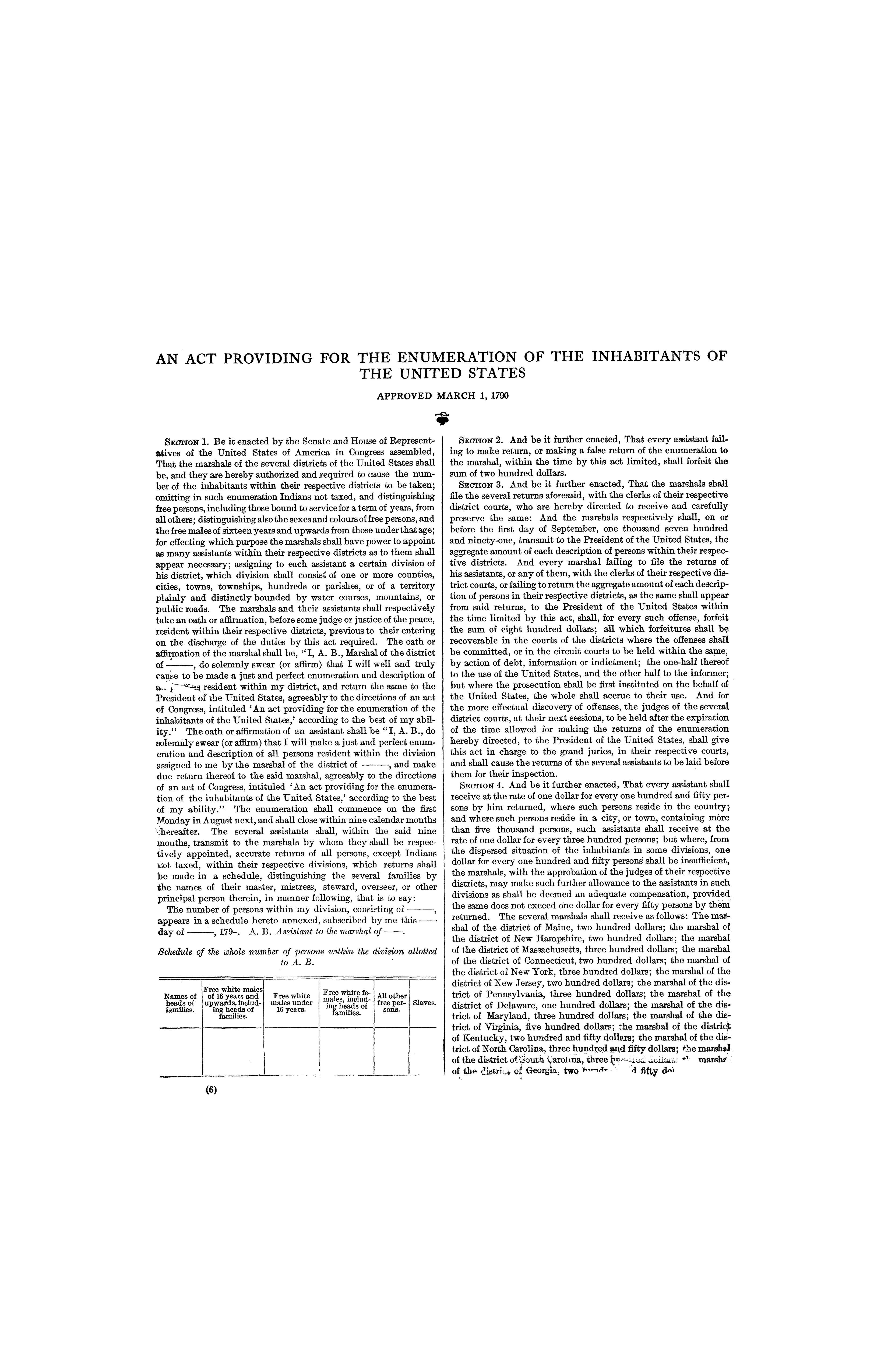
The rule also cites the record. Quoting the Supreme Court, it says: “demographic questions have been asked in every census since 1790.” It lists what past censuses have asked about: “race, ethnicity, sex, age, citizenship, health, education, occupation, housing, military service, radio ownership, age at first marriage, and native tongue.” And it says that “Congress has, at times in the past, required the collection of certain demographic information through the decennial census.”
The rule concludes: “For all these reasons, the Census Bureau is re-evaluating the proper role of these demographic questions and proposes to establish, by regulation, the standards articulated below.” It also argues that collecting such data “does not, by itself, advance the fundamental, Constitutional purpose of the decennial census.”
The census does a second job besides apportionment, and the rule names it: “The Secretary of Commerce is also required, by statute, to share final census population tabulations with participating States for purposes of (re)districting. Public Law 94-171.” Its §70.3(a) says the Bureau “shall at all times prioritize the accuracy of the population count for purposes of apportionment and (re)districting, subject to the confidentiality restrictions of 13 U.S.C. 9.”
The Census Bureau’s own page on that program says what the redistricting file has carried. “Since the first Census Redistricting Data Program, conducted as part of the 1980 census, the U.S. Census Bureau has included summaries for the major race groups specified by the Statistical Programs and Standards Office of the U.S. Office of Management and Budget (OMB) in Directive 15 (as issued in 1977 and revised in 1997).” And: “At the request of the state legislatures and the Department of Justice, for the 1990 Census Redistricting Data Program, voting age (18 years old and over) was added to the cross-tabulation of race and Hispanic origin.”
Set the rule beside the Bureau’s page. The redistricting file has carried race since 1980. The rule would remove the race question from the form used to count the population, and it says the Bureau may still ask on other surveys and receive demographic data from administrative records and other sources. The notice does not say whether race would appear in the redistricting file, or where that race data would come from if it did.
The docket’s Preliminary Regulatory Impact Analysis, the Bureau’s own, says what the race counts are used for. It describes “key dependencies” built on the annual release of intercensal estimates for race and ethnicity, such as “population controls for major federal surveys” and “required information for state and federal grants and other funding formulas.” Then it says: “To produce and release these data, the decennial census counts of the population by race and ethnicity are relied upon, as there are no other comparably accurate, comprehensive, and reliable sources of this information. Omitting race and ethnicity from the 2030 Census questionnaire would require the development of estimates from a base population derived from outdated and/or less accurate data and would deteriorate the accuracy of the estimation method itself.” The rule itself never says which census it would govern. The closest it comes is “decennial census enumeration moving forward.”
That analysis does not mention redistricting. Neither document says whether race would reach the redistricting file.
The proposal would bar questions on three subjects, make other demographic answers optional, give its reasons, cite examples from the law, and cite the record of asking since 1790.
For the docket, the deadline and how a comment becomes part of the public record, see the Signal Forge alert.
How this file was made
Every claim in the docket traces to a public document.
Its clearance record shows these checks, in order:
Receipts. Canon. Copy edit. Voice. Line edit. Proofread. Approval.
The 5 sources · What we have corrected · WR-FCT-037 · 10.5281/zenodo.23580594
Cite this file
Word Reimagined, “UNASKED,” WR-FCT-037, https://doi.org/10.5281/zenodo.23580594.
The number is permanent. WR-FCT-037 names this file today and will name the same file in ten years. Add the date you retrieved it.
This file is also deposited with Zenodo, at CERN, under 10.5281/zenodo.23580594. That copy carries the essay whole, its docket and its source ledger, and it outlives this domain.
Trace record
Every claim in this file resolves to a source in the custody ledger.
- Census Bureau, Decennial Census of the Population of Americans; Proposed Residence Criteria and Proposed Regulations for Demographic Questions (91 Fed. Reg. 57524, September 10, 2026)
U.S. Department of Commerce, Census Bureau, 'Decennial Census of the Population of Americans; Proposed Residence Criteria and Proposed Regulations for Demographic Questions,' Proposed Rule, 91 Fed. Reg. 57524-57531 (September 10, 2026). Federal Register document 2026-18481; RIN 0607-AA75; Docket No. 260903-0005; Regulations.gov docket USBC-2026-0628.
archive A
- Census Bureau, Decennial Census of the Population of Americans; Proposed Residence Criteria and Proposed Regulations for Demographic Questions; Extension of Comment Period (91 Fed. Reg. 63207, October 5, 2026)
U.S. Department of Commerce, Census Bureau, 'Decennial Census of the Population of Americans; Proposed Residence Criteria and Proposed Regulations for Demographic Questions; Extension of Comment Period,' 91 Fed. Reg. 63207 (October 5, 2026). Federal Register document 2026-20328; RIN 0607-AA75; Docket No. 260903-0005.
archive A
- Regulations.gov, docket USBC-2026-0628, document USBC-2026-0628-0001 (Proposed Rule)
Regulations.gov, docket USBC-2026-0628, document USBC-2026-0628-0001, 'Decennial Census of the Population of Americans; Proposed Residence Criteria and Proposed Regulations for Demographic Questions,' Proposed Rule, posted September 10, 2026. Comment period end, as served by the Regulations.gov v4 API on 2026-10-22: 2026-11-03T04:59:59Z (11:59:59 p.m. Eastern, November 2, 2026); open for comment: true.
web A
- U.S. Census Bureau, Decennial Census P.L. 94-171 Redistricting Data (Redistricting Data Program, summary files)
U.S. Census Bureau, Redistricting Data Program, 'Decennial Census P.L. 94-171 Redistricting Data,' summary files page.
web A
- Census Bureau, Preliminary Regulatory Impact Analysis (PRIA), docket USBC-2026-0628, document USBC-2026-0628-0002
U.S. Department of Commerce, Census Bureau, 'Decennial Census of the Population of Americans; Proposed Residence Criteria and Proposed Regulations for Demographic Questions, Docket No. 260903-0005: Preliminary Regulatory Impact Analysis,' 17 pp., posted to Regulations.gov as Supporting & Related Material, document USBC-2026-0628-0002, September 10, 2026.
archive A
Sources are graded A (primary) / B (secondary academic) / C (secondary journalism) / D (tertiary or contested). See the manifesto’s Evidence Standard for full criteria.
File custody
- File
- UNASKED
- Accession
- WR-FCT-037
- Thread
- Standalone
- Status
- published
- Published
- 2026-10-22
- As of
- 2026-10-22
Theme custody
Support is welcome and never required. The door is open; it is not a request.