finance Filed 05 · 21 5 min WR-FCT-006
Money's A Loan Before It's A Thing
One set of people is taught to survive money. Another set is taught to issue it.
I never had a relationship with money. Money was something I spent. It moved through my hands and I moved on.
Every new file, the day it is filed.
Every dollar in circulation started as somebody owing somebody. There is no original pile.
I never had a relationship with money. Money was something I spent. It moved through my hands and I moved on, and for most of my life that felt like the only arrangement available to me.
What changed wasn’t that money got more interesting. I got serious about what I wanted to build, and I realized I couldn’t build any of it without understanding the thing I’d been ignoring my whole life. You cannot route around the foundation. Sooner or later you have to go down and look at it.
So I looked. The relationship I have with money now is transactional, and that’s the honest word for it. It’s a tool. It’s leverage. It’s position. There’s nothing romantic in that, and there shouldn’t be. You don’t get to use a tool you refuse to learn.
What learning it cost me was a set of beliefs I’d carried since childhood. I spent my whole life being told money was real and debt was dangerous. Both were wrong.
Money isn’t real. It’s a value we agreed on, an illusion the whole system runs on. It holds because we all act like it holds. They say money doesn’t grow on trees. It kind of does. You just have to know which seeds to plant.
And debt isn’t the trap I was taught it was. Debt is the seed. That sounds like a contradiction until you watch how wealth actually moves: wealth is built on the backs of other people’s debt, used to acquire assets that grow while somebody else’s labor pays the debt down. The danger was never debt itself. The danger was not knowing which side of it you were standing on.
I want to be precise about where my version of the lie came from, because it didn’t come from nowhere.
I grew up check to check. That was the whole horizon. The advice I got about money was the advice you give somebody trying to survive the week: don’t get a credit card, avoid debt, use cash, work hard. It is good advice for staying afloat. It is useless advice for building anything.
Nobody taught me how money actually worked because nobody around me knew. You can’t teach what you don’t have. I’m not going to blame my parents for that. They put me in the position to get the education that finally let me see the rules. That is its own kind of inheritance.
But here is the part that matters. The rules weren’t hidden by them. The rules were hidden from them. The gap between what poor people get taught about money and what wealthy people get taught about money is not an accident. It’s the architecture. One set of people is taught to survive money. Another set is taught to issue it. Once you understand that, you stop asking how to get more money and start asking the only question that matters: where does it come from.
So here’s what they don’t tell you. Money is a loan before it is a thing.
When a bank gives somebody a mortgage, the bank doesn’t reach into a vault and hand over money that was already sitting there. The bank types a number into an account and the money exists. The loan is the money. This is not my theory. The Bank of England has stated it plainly: commercial banks create new money each time they make a loan, and that the familiar belief that banks simply lend out deposits already sitting with them has the process backwards. The Federal Reserve Bank of Philadelphia describes the same operation: a bank’s loan and the deposit it creates are entered together, two sides of one act.

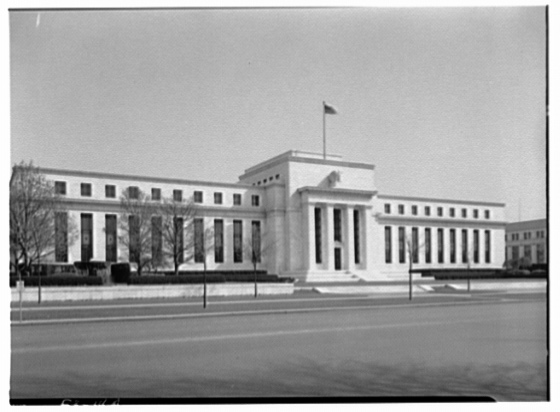
Cafeteria corner, Federal Reserve Building, ca. 1920–1950. Library of Congress.
Sit with what that means. Every dollar in circulation started as somebody owing somebody. There is no original pile. There is only the ledger, and the ledger is always somebody’s promise.
And the people at the top are not exempt from this. They’re fluent in it. The billionaires and the corporations don’t have physical money either. What they have is the potential to generate value based on who they are, what they do, and what the market demands of them. They commission new money into existence through the banks to buy real assets (land, businesses, stock) while the rest of us are taught to fear the one mechanism that creates currency in the first place. The fear is the point. A person who is afraid of the engine will never ask to drive it.
And when it fails, the taxpayer pays. The banks get bailed out. The central bank, the Federal Reserve, gets bailed out. They take taxpayer money and disguise it as a loan. They reap the benefits of success and never suffer the consequences of failure. That’s why the cycle continues. No accountability. The whole thing works like a Ponzi scheme. The bill always comes due and the taxpayer always pays it.
It made me mad, but then I got over it. Anger is not a strategy, and I have work to do.
I can’t be mad at the people gatekeeping. They’re just doing their job. It’s my job to kick the door down. It’s the law of nature and we all have our part to play.
If you truly want something in America, you’re going to have to take it. That is the country’s oldest instruction, and I’m done pretending otherwise. But there is a line I will not cross to do it. Unlike the colonizers, I’m not going to stand on the backs of my people to get it. I’m not going to steal from them. I’m going to retrieve what’s owed to me and mine, and if it won’t be freely given, I will gladly take it.
History has always been written by the winners. I’m here to make sure ours gets told and solidified.
DOCKET
- Bank of England. Quarterly Bulletin 2014 Q1, "Money creation in the modern economy" (McLeay, Radia & Thomas). Anchors the Beat 4 claim: commercial banks create new money by extending credit — the loan brings a new deposit into existence — and the common account in which banks merely lend out pre-existing deposits (the "money multiplier") is a misconception. Trust tier: primary.
- Federal Reserve Bank of Philadelphia. "How Banks Use Loans to Create Liquidity," Research in Focus, June 21, 2023. https://www.philadelphiafed.org/the-economy/banking-and-financial-markets/how-banks-use-loans-to-create-liquidity — public-facing summary of Yu & coauthor's working paper "Funding Liquidity Creation by Banks" (https://www.philadelphiafed.org/the-economy/banking-and-financial-markets/funding-liquidity-creation-by-banks). Corroborates the BoE mechanism: bank lending creates the deposit in the same operation. Reports that during 2001–2020, 92 percent of U.S. bank deposits resulted from funding liquidity created by bank lending activities, not from cash deposits — quantifying the scale of private money creation by commercial banks. Trust tier: primary.
Cite this file
Word Reimagined, “Money's A Loan Before It's A Thing,” WR-FCT-006, https://doi.org/10.5281/zenodo.22945505.
The number is permanent. WR-FCT-006 names this file today and will name the same file in ten years. Add the date you retrieved it.
This file is also deposited with Zenodo, at CERN, under 10.5281/zenodo.22945505. That copy carries the essay whole, its docket and its source ledger, and it outlives this domain.
Trace record
Every claim in this file resolves to a source in the custody ledger.
- Money creation in the modern economy
Michael McLeay, Amar Radia and Ryland Thomas. "Money creation in the modern economy." Bank of England Quarterly Bulletin 2014 Q1.
article A
- How Banks Use Loans to Create Liquidity
Federal Reserve Bank of Philadelphia. "How Banks Use Loans to Create Liquidity." Research in Focus, June 21, 2023. Public-facing summary of the working paper "Funding Liquidity Creation by Banks" (https://www.philadelphiafed.org/the-economy/banking-and-financial-markets/funding-liquidity-creation-by-banks).
article A
Sources are graded A (primary) / B (secondary academic) / C (secondary journalism) / D (tertiary or contested). See the manifesto’s Evidence Standard for full criteria.
File custody
- File
- MONEY-IS-A-LOAN-BEFORE-IT-IS-A-THING
- Accession
- WR-FCT-006
- Thread
- Standalone
- Status
- published
- Published
- 2026-05-21