power Filed 08 · 02 22 min WR-FCT-025 HOLLOWED thread
THE CONCESSION
To argue that ECOA never carried the effects test, the Bureau had to put in writing that the Fair Housing Act still does. It drew the boundary of what survives, and it drew it in daylight.
On April 22, 2026, the Consumer Financial Protection Bureau deleted the effects test from Regulation B. To make its argument, the Bureau conceded what another statute protects. That concession is load-bearing.
Every new file, the day it is filed.
On April 22, 2026, the Consumer Financial Protection Bureau published a final rule amending Regulation B, the regulation that implements the Equal Credit Opportunity Act. Federal Register document 2026-07804, Docket CFPB-2025-0039. Effective July 21, 2026.
The rule amends Section 1002.6(a) of 12 CFR Part 1002. It deletes the effects test. It adds language stating that the Act does not recognize disparate-impact liability. Since March 23, 1977, Regulation B has carried a provision allowing regulators to examine the effects of a creditor’s practices, not only the creditor’s intent. That provision is now deleted.
The Bureau proposed this change on November 13, 2025. Federal Register document 2025-19864. Comments closed December 15, 2025, thirty-two days later. The final rule published on April 22, 2026. It was issued by the CFPB alone. The Department of Justice is not a party to the rulemaking.
The Bureau’s stated purpose is that the amendments “facilitate compliance with ECOA by clarifying the obligations imposed by the statute.”
The Bureau has examined Regulation B, considered comments, and determined that, under the best reading of the statute, disparate-impact claims are not cognizable under ECOA.
That is what the document says. What follows is how it gets there, and what the argument requires the Bureau to concede.
The Bureau’s argument is textual first. It starts with a test.
In 2015, the Supreme Court held in Texas Department of Housing and Community Affairs v. Inclusive Communities Project, 576 U.S. 519, that “antidiscrimination laws must be construed to encompass disparate-impact claims when their text refers to the consequences of actions and not just to the mindset of actors, and where that interpretation is consistent with statutory purpose.”
That is the test. Does the statute’s text refer to consequences, or only to intent?
The Bureau applies this test to three federal antidiscrimination statutes.
The Fair Housing Act, Section 804(a), codified at 42 U.S.C. 3604(a), makes it unlawful to “refuse to sell or rent after the making of a bona fide offer, or to refuse to negotiate for the sale or rental of, or otherwise make unavailable or deny, a dwelling to any person because of” protected characteristics. The phrase “otherwise make unavailable” refers to consequences, not mindset. The Bureau says FHA passes.
Title VII of the Civil Rights Act, Section 703(a)(2), prohibits employment practices that “deprive or tend to deprive any individual of employment opportunities or otherwise adversely affect his status as an employee.” The phrase “otherwise adversely affect” refers to consequences. Title VII passes.
The Equal Credit Opportunity Act, Section 701(a)(1), codified at 15 U.S.C. 1691(a)(1), makes it unlawful for “any creditor to discriminate against any applicant, with respect to any aspect of a credit transaction” on the basis of race, color, religion, national origin, sex, marital status, or age. The verb is “discriminate.” There is no “otherwise make unavailable.” No “adversely affect.” No language referring to the consequences of a creditor’s actions as distinct from the creditor’s intent. The Bureau says ECOA fails the test.
The Bureau acknowledges a competing view. In 1976, the Senate Report accompanying the ECOA amendments stated that “courts or agencies are free to look at the effects of a creditor’s practices as well as the creditor’s motives or conduct in individual transactions.” The prior Board relied on this language to justify the effects test in Regulation B for decades. The Bureau rejects the approach, and reaches for a sentence to do it with: “But statutory provisions—not purposes—go through the process of bicameralism and presentment mandated by our Constitution.”
Those are not the Bureau’s words. At its own footnote 58 the rule takes them from the dissent in Inclusive Communities, the same case whose majority it relies on elsewhere for what the Fair Housing Act has and ECOA lacks. It quarries one decision twice. The sentence it uses to retire the effects test in credit comes from the side that lost.
The argument is textual first. It says the statute’s words do not support disparate impact, and it adds that applying disparate-impact liability in the credit context “may undermine ECOA’s purposes.”
To make this argument, the Bureau has to say out loud what the other statutes have that ECOA lacks. Nobody extracted it. The Bureau needed it, because a contrast requires two things, and it volunteered the second one.
It must name the language. It names FHA’s “otherwise make unavailable.” It must cite the precedent. It cites Inclusive Communities holding FHA’s effects test valid. It must acknowledge that FHA’s protections survive its own rule. In its own analysis, the Bureau notes that the rule “may have limited impact on covered persons since they are still subject to other antidiscrimination statutes such as the FHA and State laws similar to ECOA,” and that “the legal risk under other statutes remains unchanged.”
Those sentences are doing work. They tell lenders: this rule changes ECOA, not FHA. Your mortgage compliance obligations still apply. Disparate impact still applies to the products the Fair Housing Act covers.
The concession is not incidental. It is the argument. The Bureau’s textual analysis works by contrast: ECOA lacks what FHA has. That sentence only has meaning if FHA has it. The Bureau is precise about where. It finds the effects language in section 804(a), whose “otherwise make unavailable” the Court read as referring to consequences. Section 805, the provision that governs housing credit, has no such language, and the Bureau says the Court reached disparate impact there by inference: “Although section 805(a) of the FHA lacks such effects-based language, the Court determined that both Harris and the presence of section 805(c) suggested that disparate impact should nevertheless apply under section 805(a).” Without the concession, the analysis has no comparative anchor. The Bureau would be arguing that a word is missing without being able to point to the statute that has it.
An anonymous commenter, as the final rule summarizes the comment, makes the same move. The rule reports that the commenter indicated that “amending Regulation B is unlikely to have any material impact on the organization or structure of fair lending compliance programs maintained by banks; according to the commenter, covered banks will remain subject to disparate-impact claims that might be asserted in State enforcement actions or by private parties in litigation, and therefore bank compliance programs must continue to appropriately identify and mitigate those risks.”
Read what the commenter says the banks remain exposed to. Not the FHA. Not the Bureau. Claims “asserted in State enforcement actions or by private parties in litigation.”
That is the patchwork the commenter names: State enforcement or a private suit.
The question this casefile asks is specific. Where does the FHA cover, and where does it not?
The answer is in the statutes.
ECOA defines “credit” at 15 U.S.C. 1691a(d) as “the right granted by a creditor to a debtor to defer payment of debt or to incur debts and defer its payment or to purchase property or services and defer payment therefor.” That definition covers every deferred-payment transaction in the economy. Every auto loan. Every credit card. Every student loan application. Every small-business line of credit. Every commercial lending decision. The statute says “any aspect of a credit transaction.” It does not say “mortgage.” It does not say “dwelling.” It says “any.”
The Fair Housing Act is narrower by design. Section 805, codified at 42 U.S.C. 3605, covers “residential real estate-related transactions.” The statute defines these as the making or purchasing of loans, or the provision of other financial assistance, for purchasing, constructing, improving, repairing, or maintaining a dwelling, or secured by residential real estate, and the selling, brokering, or appraising of residential real property.
The overlap is the home loan: the purchase mortgage and, by the statute’s own words, loans to improve, repair or maintain a dwelling and loans secured by residential real estate.
Effects-Test Coverage Map
Before and after July 21, 2026
Credit Type
Pre-7/21
Post-7/21
State Backstop
Home loans
ECOA + FHA
FHA
(federal covers)
Auto loan
ECOA
(none via Regulation B)
NY; others not surveyed
Credit card
ECOA
(none via Regulation B)
NY; others not surveyed
Student loan
ECOA
(none via Regulation B)
NY; others not surveyed
Small business credit
ECOA
(none via Regulation B)
NY; others not surveyed
Commercial lending
ECOA
(none via Regulation B)
NY; others not surveyed
NY: Executive Law 296-a, “any form of credit.” The regulator issued its letter the same day the rule published.
NJ: N.J.A.C. 13:16, adopted November 5, 2025, effective December 15, 2025; its lending provision covers housing financial assistance. Rest of the country: not surveyed.
Source: 15 U.S.C. 1691 scope vs. 42 U.S.C. 3605 scope (uscode.house.gov, verified 2026-07-09).
The Bureau’s reassurance is accurate for the first row of this map. For the rows that follow, outside loans secured by residential real estate, it points to “other State and Federal fair lending laws” and to “State laws similar to ECOA,” and names no State.
The gap is not an oversight. It is a structural consequence of the argument. The Bureau’s own textual analysis, which concedes that the FHA reaches effects, through section 804(a)‘s text and, for section 805, through Harris and section 805(c), simultaneously defines the boundary of what remains protected. The concession draws the line. Everything on one side keeps a federal effects test. Everything on the other side loses the effects test Regulation B carried.
There is a popular framing of this rule. It says disparate impact is dead in lending.
The document does not say that. The document never asserts authority over Fair Housing Act claims. It explicitly acknowledges that FHA obligations remain. It summarizes an anonymous commenter who says amending Regulation B is “unlikely to have any material impact on the organization or structure of fair lending compliance programs maintained by banks.” It addresses ECOA and Regulation B. It does not touch the Fair Housing Act, Title VII, state fair-lending statutes, or private rights of action under any other law.
The overstatement runs in both directions. Overstating the rule’s reach ignores the FHA backstop on home loans. Understating it ignores the gap on auto loans, credit cards, student loans, and small business and commercial credit not secured by residential real estate. Both framings read one half of the document and stop. One half says home loans are still covered. The other half does not say what happens to the rest.
This casefile reads the whole document.
The map organized fear. That is what this archive’s third casefile, Redline, documents: a federal agency graded neighborhoods A through D for “residential security,” and the grade taught the country to read Black neighborhoods as financially suspicious. The form had a line headed Negro, and the surveyors filled it in. Around it, the vocabulary was administrative. Detrimental influences. Infiltration. Declining.
Disparate impact was the tool built to read the administrative version. It did not require the speaker to confess. It read the pattern. It said: you do not need the confession. You have the receipt. The receipt is enough.
The Bureau’s argument is textual first, with a purposes claim behind it. The argument is narrow and it may be correct on its own terms. But narrow arguments create specific gaps. And the gap this one creates falls on the credit products where the receipt was hardest to name in the first place: the auto loan that prices higher for reasons the borrower cannot see, the credit card that scores lower by a method the applicant cannot audit, the small-business line that never arrives and never explains itself.
The tool that recognizes the cycle is being unbuilt.
Trace Record
1930s HOLC survey. Neighborhoods graded A through D.
1968 Fair Housing Act. Section 804(a): “otherwise make unavailable.”
1974 Equal Credit Opportunity Act. Section 701(a): “discriminate.”
1976 ECOA amendments. Senate Report: “free to look at the effects.”
1977-03-23 Regulation B revision takes effect, with the effects test in a footnote (42 FR 1242, 1255 n.7; published January 6, 1977).
2015 Inclusive Communities. Supreme Court: textual test for effects-based liability.
2025-11-13 CFPB NPRM. Bureau applies the test. ECOA fails.
2025-12-15 New Jersey. Disparate-impact rules take effect (adopted 2025-11-05).
2026-04-22 CFPB Final Rule. Effects test deleted from Regulation B.
2026-04-22 NYDFS industry letter. State effects test reaffirmed.
2026-07-08 WR correction. Four errors in Without a Word for It (bdb7e10).
2026-07-21 Effective date.
On the Table
On the same day the Bureau published its final rule, the New York State Department of Financial Services issued an industry letter titled “New York State’s Fair Lending Law - New York Executive Law Section 296-a.” The letter reminded regulated entities that under Executive Law Section 296-a, “covered credit decisions that result in a disparate impact may constitute an unlawful discriminatory practice.” The statute reaches discrimination “in the granting, withholding, extending or renewing, or in the fixing of the rates, terms or conditions of, any form of credit.” The letter does not reference the CFPB’s final rule by name. It did not need to.
New Jersey’s Division on Civil Rights adopted disparate-impact rules on November 5, 2025, effective December 15, 2025. Their lending provision covers housing financial assistance (N.J.A.C. 13:16-4.6). This house has not read any other state’s text. We do not cite what we have not read.
We have verified explicit effects-test text in one state’s regulation, New Jersey’s, and one state regulator’s published reading of its statute, New York’s; the statute’s own text does not use the term. We have not surveyed the rest, and we do not know how many others carry one.
Whether the removal of Regulation B commentary forecloses private disparate-impact claims under ECOA itself, or only the Bureau’s regulatory enforcement, remains on the table. The Bureau’s rule governs its own enforcement. Courts may read the statute independently.
The rule took effect on July 21, 2026. The federal gap on auto loans, credit cards, student loans, and small-business credit not secured by residential real estate is real for borrowers in states without an effects standard of their own, a number we have not counted. What remains after the concession is a patchwork, and we have read two of its pieces.
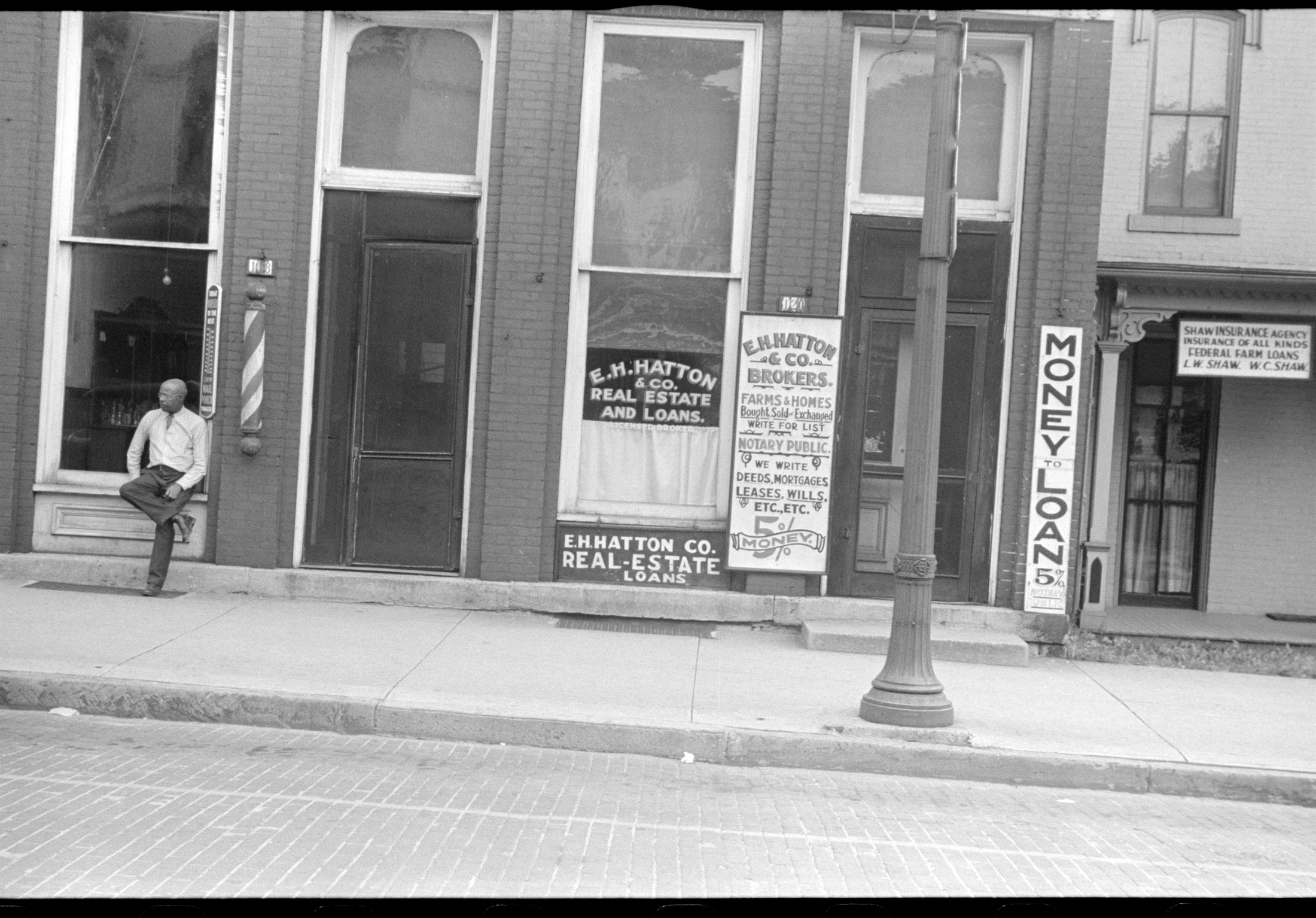
Look at the photograph at the top of this file. A man in a light checked shirt and tie, leaning against a window sill in the summer of 1938, beside a barber pole. In the next storefront: Real Estate and Loans. Money to Loan, 5%. We write deeds, mortgages, leases, wills. On the building beyond, an insurance agency’s sign: Federal Farm Loans.
He is standing right next to the credit. The photograph cannot tell us whether he was ever inside it. What the effects test was built to reach is the harm you can measure without anyone confessing to it.
The instrument built to see that harm is being removed. Read the rule. Then read the statute beside it, and notice which one still says any.
Correction
Corrected 2026-10-01. This casefile published on August 2, 2026. A reading of the whole casefile against its primaries found six errors, named here rather than quietly repaired. The argument stands: to show what ECOA lacks, the Bureau’s rule says in its own words that the Fair Housing Act reaches effects, and that the legal risk under other statutes remains.
A commenter’s paraphrase credited to the Bureau. The casefile said: In its response to public comments, the Bureau writes that “the impact of the amendments to Regulation B will be substantially limited by the ongoing need to comply with other State and Federal fair lending laws, such as the FHA.” Those words are the final rule’s report of one industry commenter, who “agreed with the Bureau’s observation in the proposed rule” (91 Fed. Reg. 21629). The closest passages in the proposed rule read: “These benefits, however, may be limited by the ongoing need to comply with other State and Federal fair lending laws” (90 Fed. Reg. 50915), and “covered persons are still liable under other antidiscrimination statutes such as the FHA and state laws similar to ECOA” (90 Fed. Reg. 50916). The passage now quotes the Bureau’s own final-rule analysis: the rule “may have limited impact on covered persons since they are still subject to other antidiscrimination statutes such as the FHA and State laws similar to ECOA” (21661), and “the legal risk under other statutes remains unchanged” (21662). The docket now carries those words and pages, and the final rule’s “These benefits, however, are bounded by the ongoing need to comply with other State and Federal fair lending laws” (21660).
The rule’s argument called purely textual. The casefile said twice that the rule “does not say disparate impact is bad policy.” The rule says “the application of disparate-impact liability in the credit context may undermine ECOA’s purposes.” Both passages now say the argument is textual first, with a purposes claim behind it.
A wrong year and span. The casefile said “For fifty years, since 1976,” Regulation B had carried the effects test, and its Trace Record put the effects test in Regulation B in 1976. The effects-test language entered Regulation B in a footnote to a revision published January 6, 1977 (42 FR 1242, 1255 n.7), which “will become effective on March 23, 1977,” as the Federal Reserve Bank of Dallas reprint of the notice records. 1976 is the year of the ECOA amendments and the Senate Report. The sentence now gives the effective date, and the Trace Record now has a row for each year.
New Jersey’s dates and scope. The casefile said New Jersey “adopted” its rules on December 15, 2025, “effective on adoption,” and called them “an explicit disparate-impact regulation for financial lending.” The Division on Civil Rights adopted the rules on November 5, 2025; they took effect December 15, 2025. Their lending provision covers housing financial assistance (N.J.A.C. 13:16-4.6). The docket’s note that the rules codify a “three-step burden-shifting framework” now quotes the Division: it “codifies the two-step burden-shifting framework only in the housing context.”
“Only the mortgage.” The casefile said “The overlap is the mortgage. Only the mortgage.” The statute it quotes, 42 U.S.C. 3605, also reaches loans to improve, repair or maintain a dwelling and loans secured by residential real estate, including a business loan secured by residential real estate. The sentence now says so; the coverage map’s first row now reads “Home loans” in place of “Residential mortgage,” and its federal cells for the other rows now read “(none via Regulation B)” in place of “(none federal).”
An invented particular. The casefile called the commenter “An industry commenter, quoted in the final rule,” and then “An industry lawyer, writing to reassure clients.” The rule describes “An anonymous commenter” and summarizes the comment in its own words. The passage now says so, the commenter’s sentence is quoted to its end, and the lawyer is cut.
Smaller changes made at the same time, each quoted as it was and as it now reads:
- The Bureau’s stated purpose, “would facilitate compliance with ECOA by clarifying the obligations imposed by the statute,” is the proposed rule’s wording. It now quotes the final rule: “facilitate compliance with ECOA by clarifying the obligations imposed by the statute.”
- “The final rule published four months after that.” now reads “The final rule published on April 22, 2026.”
- The pull quote “Under the best reading of the statute, disparate-impact claims are not cognizable under ECOA.” began mid-sentence. It now quotes the whole sentence: “The Bureau has examined Regulation B, considered comments, and determined that, under the best reading of the statute, disparate-impact claims are not cognizable under ECOA.”
- “The Bureau’s argument is textual. It starts with a test.” now reads “The Bureau’s argument is textual first. It starts with a test.”
- The ECOA quotation “any creditor to discriminate against any applicant, with respect to any aspect of a credit transaction on the basis of” ran past the point where the statute breaks into its list. The quotation now stops at “any aspect of a credit transaction”.
- “That sentence is doing work. It tells lenders:” now reads “Those sentences are doing work. They tell lenders:”
- The contrast passage now says where the Bureau finds the FHA’s effects language: in section 804(a)‘s “otherwise make unavailable.” Of section 805, the lending provision, it quotes the Bureau: “Although section 805(a) of the FHA lacks such effects-based language, the Court determined that both Harris and the presence of section 805(c) suggested that disparate impact should nevertheless apply under section 805(a).” Later, “which concedes that the FHA has the effects-based language” now reads “which concedes that the FHA reaches effects, through section 804(a)‘s text and, for section 805, through Harris and section 805(c).”
- “An industry lawyer, writing to reassure clients, has just described the patchwork. State enforcement, or a private suit, or nothing. The reassurance applies there. It does not extend beyond it.” now reads “That is the patchwork the commenter names: State enforcement or a private suit.”
- “It quotes an industry commenter who says bank compliance programs will not change.” now reads “It summarizes an anonymous commenter who says amending Regulation B is ‘unlikely to have any material impact on the organization or structure of fair lending compliance programs maintained by banks.’”
- “For every row that follows, it gestures at ‘other State and Federal fair lending laws’ and names none of them.” now reads “For the rows that follow, outside loans secured by residential real estate, it points to ‘other State and Federal fair lending laws’ and to ‘State laws similar to ECOA,’ and names no State.”
- In the coverage map, “NY, NJ only” now reads “NY; others not surveyed.” New Jersey’s rule text reaches lending through housing financial assistance, and this house has not read whether the state’s law reaches auto, card, student or business credit. The map’s New Jersey note now gives both dates and the scope.
- “Everything on the other side loses the only one it had.” now reads “Everything on the other side loses the effects test Regulation B carried.”
- “Overstating the rule’s reach ignores the FHA backstop on residential mortgages. Understating it ignores the gap on auto loans, credit cards, student loans, small business credit, and commercial lending.” now reads “Overstating the rule’s reach ignores the FHA backstop on home loans. Understating it ignores the gap on auto loans, credit cards, student loans, and small business and commercial credit not secured by residential real estate.” “One half says the mortgage is fine.” now reads “One half says home loans are still covered.”
- “California, Massachusetts, and Illinois have enforcement history on non-mortgage credit discrimination, including auto lending and student-loan algorithms, but this house has not independently verified explicit effects-test statutory text for any of the three.” is cut. No document in this casefile supports it.
- “We have verified explicit statutory or regulatory effects-test text in two states.” now reads “We have verified explicit effects-test text in one state’s regulation, New Jersey’s, and one state regulator’s published reading of its statute, New York’s; the statute’s own text does not use the term.” In the docket, “This is the SECOND of the two states the essay says it has verified” now reads “This is the one state regulation the essay says it has verified.”
- “The federal gap on auto loans, credit cards, student loans, and small-business credit is real for borrowers outside the handful of states that maintain independent standards.” now reads “The federal gap on auto loans, credit cards, student loans, and small-business credit not secured by residential real estate is real for borrowers in states without an effects standard of their own, a number we have not counted.”
- The New York letter’s title now carries its full name, “New York State’s Fair Lending Law - New York Executive Law Section 296-a.” The statute quotation “the granting, withholding, extending, or renewing, or in the fixing of the rates, terms, or conditions of any form of credit” was the letter’s paraphrase. It now quotes the statute: “in the granting, withholding, extending or renewing, or in the fixing of the rates, terms or conditions of, any form of credit.”
- The photographs: in the opening description, “Painted signs across the windows read” now reads “Signs on a window and across the storefront read.” In the closing passage, “A man in a white shirt and tie, leaning in a doorway on a summer afternoon in 1938” now reads “A man in a light checked shirt and tie, leaning against a window sill in the summer of 1938,” and “In the next windows” now reads “In the next storefront,” with “Federal Farm Loans” now credited to the insurance agency’s sign on the building beyond. “He is on the outside of it. Nobody had to tell him why, and nobody wrote it down” is cut; the Library of Congress record says nothing of the man but that he is there. “The instrument that could see him is being removed.” now reads “The instrument built to see that harm is being removed.”
- The reference to this archive’s REDLINE casefile now matches that casefile’s correction of 2026-09-30: “and the grade taught lenders, planners, and insurers how to read Black life as financially suspicious. The vocabulary was administrative from the first survey card.” now reads “and the grade taught the country to read Black neighborhoods as financially suspicious. The form had a line headed Negro, and the surveyors filled it in. Around it, the vocabulary was administrative.” “The language cleaned itself up when power needed its hands presentable.” is cut.
Sources: Consumer Financial Protection Bureau, final rule, 91 Fed. Reg. 21620 (April 22, 2026), and proposed rule, 90 Fed. Reg. 50901 (November 13, 2025), at federalregister.gov; Board of Governors of the Federal Reserve System, Regulation B revision, 42 Fed. Reg. 1242 (January 6, 1977), as reprinted in Federal Reserve Bank of Dallas Circular No. 77-10 (January 18, 1977), at fraser.stlouisfed.org; 42 U.S.C. 3605, 3604; 15 U.S.C. 1691, 1691a; New Jersey Division on Civil Rights, N.J.A.C. 13:16, 57 N.J.R. 12(2) (December 15, 2025), as posted by the New Jersey Attorney General; New York Department of Financial Services, industry letter of April 22, 2026, and N.Y. Executive Law 296-a; Library of Congress, item 2017732402. Read on October 1, 2026.
If this is your file
The Bureau removed the effects test from Regulation B. It did not remove your right to be told why, and by its own argument it did not touch the Fair Housing Act.
- Ask the creditor for the specific reasons your application was denied. A creditor that takes adverse action owes you a statement of reasons, in writing on request.
- File a complaint about the credit decision. The Bureau routes it to the company and publishes the response.
- If the credit was for a home, file separately on the housing side. The Bureau's own argument here concedes that the Fair Housing Act still reaches effects, not only intent.
This archive names offices and documents. It does not give legal advice and cannot tell you how a filing will come out.
DOCKET
- This house docketed this proceeding wrong on June 3, 2026. Four factual errors corrected July 8, 2026 (bdb7e10). What follows is sourced to the documents.
- Consumer Financial Protection Bureau, Final Rule, Equal Credit Opportunity Act (Regulation B). Federal Register document 2026-07804, published April 22, 2026, effective July 21, 2026. Docket No. CFPB-2025-0039. Amends 12 CFR Part 1002, Sec. 1002.6(a). Deletes the effects test and adds language stating the Act does not recognize disparate-impact liability. Trust tier: primary (govinfo.gov, fetched 2026-07-08).
- Consumer Financial Protection Bureau, Notice of Proposed Rulemaking, Equal Credit Opportunity Act (Regulation B). Federal Register document 2025-19864, published November 13, 2025. Comments closed December 15, 2025. Same docket. Proposes deleting the effects test from Sec. 1002.6(a). Trust tier: primary (govinfo.gov, fetched 2026-07-08).
- Bureau concession (FR doc 2026-07804, at pages 21661 and 21662). The Bureau notes that the rule "may have limited impact on covered persons since they are still subject to other antidiscrimination statutes such as the FHA and State laws similar to ECOA" and that "the legal risk under other statutes remains unchanged." Trust tier: primary.
- Bureau benefits analysis (FR doc 2026-07804, at page 21660): "These benefits, however, are bounded by the ongoing need to comply with other State and Federal fair lending laws." Trust tier: primary.
- Bureau acknowledgment (FR doc 2025-19864). The Bureau cites Inclusive Communities as holding that disparate-impact claims are cognizable under the Fair Housing Act. Trust tier: primary.
- Anonymous commenter (FR doc 2026-07804, at page 21629, as the Bureau summarizes the comment). The commenter indicated that amending Regulation B is "unlikely to have any material impact on the organization or structure of fair lending compliance programs maintained by banks" and that covered banks will remain subject to disparate-impact claims in State enforcement actions or private litigation. Trust tier: primary.
- Bureau legislative history rejection (FR doc 2026-07804). The Bureau rejects reliance on the 1976 Senate Report. The sentence it quotes for that proposition, verbatim: 'But statutory provisions—not purposes—go through the process of bicameralism and presentment mandated by our Constitution.' THE WORDS ARE NOT THE BUREAU'S. The rule's footnote 58 reads 'Id. at 553,' chaining through footnote 55, 'Inclusive Communities, 576 U.S. at 550 n.3 (Thomas, J., dissenting)'; the rule cites Alito's separate dissent distinctly, at 577-78. The Bureau relies on the same case's MAJORITY elsewhere, for the holding that disparate-impact claims are cognizable under the FHA. Full text verified against federalregister.gov 2026-08-02. Trust tier: primary.
- Equal Credit Opportunity Act, 15 U.S.C. 1691(a)(1). Prohibits discrimination in any aspect of a credit transaction. ECOA defines credit at 15 U.S.C. 1691a(d) to cover all deferred-payment transactions. No effects-based language. Trust tier: primary (uscode.house.gov, verified 2026-07-09).
- Fair Housing Act, 42 U.S.C. 3604(a). Prohibits making a dwelling unavailable on the basis of protected characteristics. Contains the phrase otherwise make unavailable or deny, which is effects-based language. Trust tier: primary (uscode.house.gov, verified 2026-07-09).
- Title VII of the Civil Rights Act of 1964, Sec. 703(a)(2), codified at 42 U.S.C. 2000e-2(a)(2). Verbatim, as quoted in the essay: 'deprive or tend to deprive any individual of employment opportunities or otherwise adversely affect his status as an employee.' The phrase 'otherwise adversely affect' is the effects-based language the Bureau's contrast turns on. Trust tier: primary (verified against the U.S. Code 2026-08-02; this quotation previously carried NO docket item).
- Fair Housing Act, 42 U.S.C. 3605. Limits FHA credit-discrimination provisions to residential real estate-related transactions: loans for purchasing, constructing, improving, repairing, or maintaining a dwelling, or secured by residential real estate. Trust tier: primary (uscode.house.gov, verified 2026-07-09).
- Texas Dept. of Housing v. Inclusive Communities Project, 576 U.S. 519 (2015). Antidiscrimination laws must be construed to encompass disparate-impact claims when their text refers to the consequences of actions and not just to the mindset of actors. Trust tier: primary.
- New York Executive Law Sec. 296-a. Covers any form of credit. NYDFS industry letter dated April 22, 2026: covered credit decisions that result in a disparate impact may constitute an unlawful discriminatory practice. Trust tier: primary (dfs.ny.gov, fetched 2026-07-09).
- New Jersey, N.J.A.C. 13:16, Disparate Impact Discrimination. Adopted by the Division on Civil Rights, Department of Law and Public Safety, on November 5, 2025, effective December 15, 2025; published at 57 N.J.R. 12(2), December 15, 2025. Rule text confirmed firsthand 2026-08-02 from the Attorney General's own posting (njoag.gov), sections 13:16-1.1 through 13:16-6.2. Its lending provision covers housing financial assistance (13:16-4.6), alongside rules for employment, housing, public accommodations and contracting. NOTE, against our own interest: the Division says the rules "codify existing legal rights and precedents, rather than creating new standards," and that it "codifies the two-step burden-shifting framework only in the housing context." This is the one state regulation the essay says it has verified, and it previously carried NO docket item. Trust tier: primary.
Cite this file
Word Reimagined, “THE CONCESSION,” WR-FCT-025, https://doi.org/10.5281/zenodo.23076767.
The number is permanent. WR-FCT-025 names this file today and will name the same file in ten years. Add the date you retrieved it.
This file is also deposited with Zenodo, at CERN, under 10.5281/zenodo.23076767. That copy carries the essay whole, its docket and its source ledger, and it outlives this domain.
Trace record
Every claim in this file resolves to a source in the custody ledger.
- CFPB, Equal Credit Opportunity Act (Regulation B): Disparate-Impact Rulemaking (2025 to 2026)
TWO documents. (1) Notice of Proposed Rulemaking: CFPB, 'Equal Credit Opportunity Act (Regulation B),' 90 Fed. Reg., Federal Register document 2025-19864, published 13 November 2025; comments closed 15 December 2025. (2) FINAL RULE: CFPB, 'Equal Credit Opportunity Act (Regulation B),' 91 Fed. Reg. (Vol. 91, No. 77), Federal Register document 2026-07804, published 22 April 2026, RIN 3170-AB54, Docket CFPB-2025-0039. ACTION: Final rule.
archive A
- Equal Credit Opportunity Act, 15 U.S.C. 1691
Equal Credit Opportunity Act, 15 U.S.C. 1691 (1974, as amended). Prohibits discrimination in any aspect of a credit transaction on the basis of race, color, religion, national origin, sex, marital status, or age. Does not contain effects-based language.
archive A
- Equal Credit Opportunity Act Definitions, 15 U.S.C. 1691a
Equal Credit Opportunity Act, 15 U.S.C. 1691a (1974, as amended). Definitions. Subsection (d): credit means the right granted by a creditor to a debtor to defer payment of debt or to incur debts and defer its payment or to purchase property or services and defer payment therefor. Subsection (e): creditor means any person who regularly extends, renews, or continues credit.
archive A
- Fair Housing Act, 42 U.S.C. 3604
Fair Housing Act, 42 U.S.C. 3604 (1968, as amended). Section 804(a). Makes it unlawful to refuse to sell or rent, or to otherwise make unavailable or deny, a dwelling to any person because of race, color, religion, sex, familial status, or national origin.
archive A
- Fair Housing Act, 42 U.S.C. 3605
Fair Housing Act, 42 U.S.C. 3605 (1968, as amended). Section 805. Discrimination in residential real estate-related transactions. Covers the making or purchasing of loans for purchasing, constructing, improving, repairing, or maintaining a dwelling, or secured by residential real estate, and the selling, brokering, or appraising of residential real property.
archive A
- Texas Dept. of Housing v. Inclusive Communities Project, 576 U.S. 519 (2015)
Texas Department of Housing and Community Affairs v. Inclusive Communities Project, Inc., No. 13-1371, 576 U.S. 519 (2015). Decided June 25, 2015. Majority opinion by Justice Kennedy.
archive A
- NYDFS Industry Letter: New York State's Fair Lending Law - New York Executive Law Section 296-a (April 22, 2026)
New York State Department of Financial Services, Industry Letter, 'New York State's Fair Lending Law - New York Executive Law Section 296-a,' dated April 22, 2026. Reminds regulated entities of Executive Law Section 296-a obligations.
archive A
- Title VII, Civil Rights Act of 1964, 42 U.S.C. 2000e-2
Title VII of the Civil Rights Act of 1964, Sec. 703, codified at 42 U.S.C. 2000e-2, 'Unlawful employment practices.' Subsection (a)(2) makes it unlawful for an employer 'to limit, segregate, or classify his employees or applicants for employment in any way which would deprive or tend to deprive any individual of employment opportunities or otherwise adversely affect his status as an employee, because of such individual's race, color, religion, sex, or national origin.'
archive A
Sources are graded A (primary) / B (secondary academic) / C (secondary journalism) / D (tertiary or contested). See the manifesto’s Evidence Standard for full criteria.
File custody
- File
- THE-CONCESSION
- Accession
- WR-FCT-025
- Thread
- HOLLOWED
- Status
- published
- Published
- 2026-08-02
- Last updated
- 2026-10-01