history Filed 09 · 22 7 min WR-FCT-033 ERASED thread
SUBSIDIZED
A government photograph of an all-Black town, and the sentence filed underneath it that hands the founding to a railroad
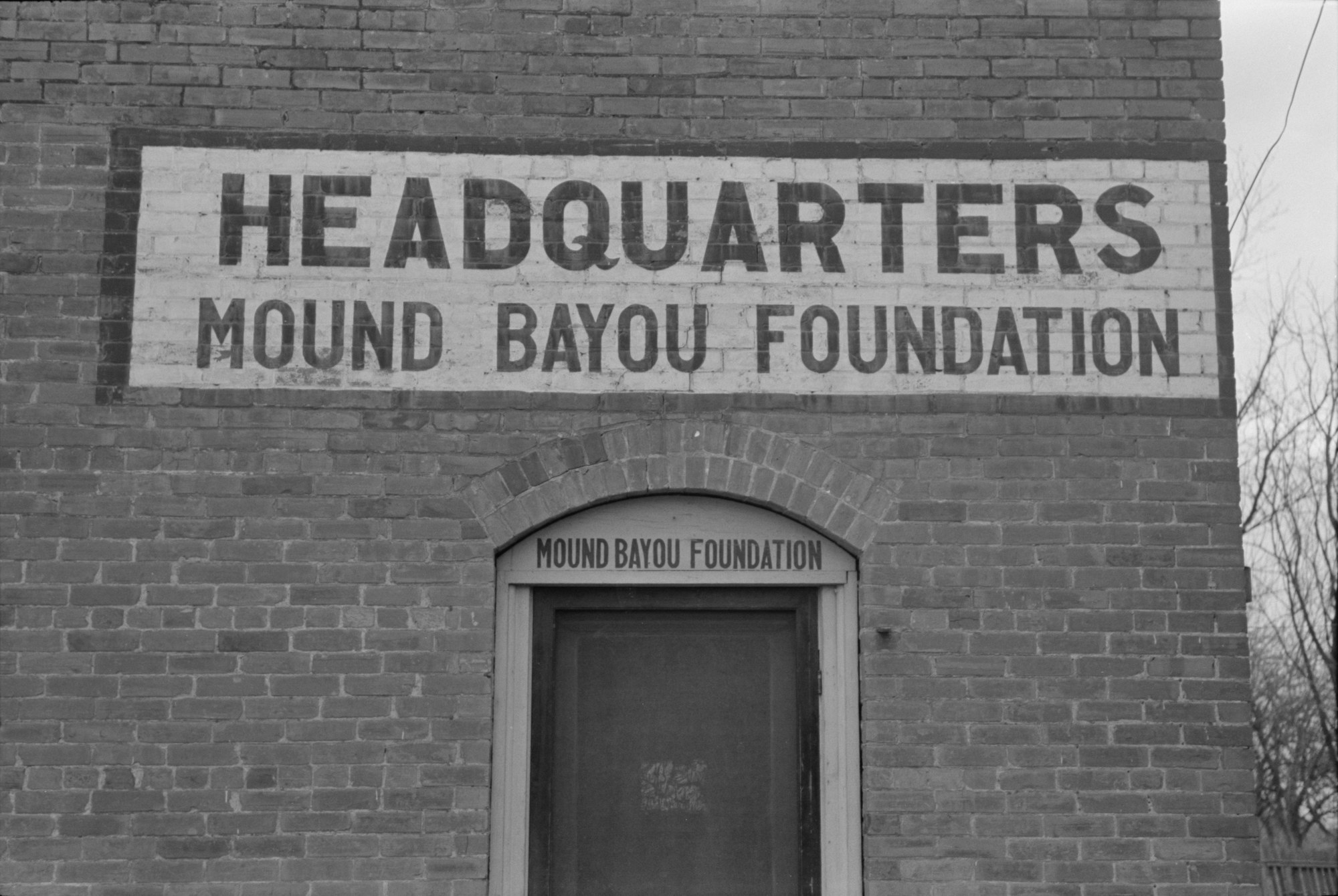
Mound Bayou painted its own name on its own brick. The federal caption credited the town to a railroad company. A second federal document, filed in 1975, credited it to the man who chose the ground.
Every new file, the day it is filed.
The record did not deny that the town existed. It photographed the town, and then filed the founding somewhere else.
In January 1939 a photographer working for the Farm Security Administration stood in front of a brick building in Mound Bayou, Mississippi, and made a picture of a wall.
The wall is not subtle. HEADQUARTERS runs across it in letters nearly its full width. MOUND BAYOU FOUNDATION sits underneath in letters almost as large. Over the doorway, on a smaller board, in case the wall had not been clear enough, it says MOUND BAYOU FOUNDATION again.
The town says its own name twice in a single frame.
Then the photograph went into a federal file, and somebody wrote the title it would be found under:
“Headquarters of Mound Bayou Foundation, Mound Bayou, Mississippi. Only all-Negro town in this section. This town was founded and is subsidized by the Yazoo Mississippi Valley Railroad”
Read the last sentence again. Not “served by.” Not “near.” Founded. And subsidized, in the present tense, in 1939.
The picture shows a town’s own institution, with its own name on its own brick. The sentence filed with the picture assigns that town to a corporation.
The other federal document
In October 1975, a different arm of the same government wrote about the same town. The National Register of Historic Places nomination for the I. T. Montgomery House was prepared by Lynne Gomez Graves of the Afro-American Bicentennial Corporation, and it tells the founding a different way.
A nomination is a document with a job. It exists to get a property listed, so it argues that a place matters.
It names two men: “Isaiah Thornton Montgomery and his cousin Benjamin Green”. It describes a railroad land grant through the Delta, then what Montgomery did with the offer:
“The assistance of Isaiah Montgomery was sought in soliciting black workers. He, realizing the possibilities that it offered for another attempt at black self-government, began an immediate investigation of its feasability. He finally decided upon the site of the present town of Mound Bayou”
And then what the settlers did:
“Many of the settlers of the former colony came to Mound Bayou in July 1887, and began to carve a town out of the wilderness and swampland. It was the inspiration of Montgomery that caused other blacks from Louisiana, Alabama, and Georgia to join the effort.”
One federal record says a railroad founded the town. Another federal record says a man investigated the ground, chose it, and other people came and cut a town out of a swamp.
The two documents do not even agree on which railroad. The 1939 caption names the Yazoo Mississippi Valley. The 1975 nomination names the Louisville, New Orleans and Texas. This file does not reconcile them. No document that does has been read. They are recorded here as printed, which is the only honest thing to do with two records that disagree.
What the railroad is recorded as believing
The nomination also preserves the reasoning, and it is worth sitting with, because it is the part nobody puts on a plaque. The document states it plainly, in its own spelling:
“It was the belief of railroad company officials that only members of the black race had the ability to adapt to life in a semi-tropical climate which was conducive to maleria.”
That word is the document’s. It is reproduced here exactly as typed, because a quotation that has been tidied is no longer evidence.
So the land was not a gift, and it was not a reward. By the record’s own account it was a calculation about who could be spent. Swamp that was believed to kill white settlers was believed not to kill Black ones, and the grant followed from that belief.
What happened next is the part the caption leaves out. The people it was offered to took the calculation and built a town on top of it.
Before Mound Bayou there was Davis Bend
The nomination records a predecessor. A settlement at Davis’ Bend, “twenty miles south of Vicksburg on the Mississippi River,” established at the close of the Civil War in 1865. It ran for a while and then it did not:
“The settlement survived for eighteen years.”
Recurring floods ended it. The relatives and friends of Montgomery and Green, the document says, “abandoned the small settlement and moved to Vicksburg where they awaited another opportunity to establish their own community.”
Eighteen years of building, and then a wait. Mound Bayou was the second attempt.
The seat
In 1890, Isaiah T. Montgomery sat in a room in Jackson that was assembled to take the vote away.
The Journal of the Proceedings of the Constitutional Convention of the State of Mississippi, 1890, prints the delegates by county. On that roll:
“Bolivar — G. P. Melchior, I. T. Montgomery.”
Bolivar is Mound Bayou’s county. The man who chose the ground was one of its two delegates.
The same Journal prints the committee rosters. The Committee on Elective Franchise, Apportionment and Elections is the committee that wrote the article on who could vote. Its roster runs for seven printed lines of surnames, and it ends like this:
“Watson, Resan, of Claiborn ; and Montgomery.”
Last. Alone, after the semicolon. The convention’s only Black delegate was seated on the committee that would disenfranchise Black Mississippi.
What he argued in that room is not established in this file. He is reported to have given a speech in August 1890. It was reportedly printed in the New York World that September and it has been anthologized since. Neither has been obtained and read for this archive, so it will not be characterized here. What he said is contested. Where he sat is printed in the state’s own record.
One thing he did is printed there too. At the procedural stage he offered a resolution: that every proposition or amendment to the Constitution be referred to the proper committee, in his words, “without debate,” with a further clause allowing that committee to send a matter back for printing before making its final report. Mr. Muldrow offered a substitute. Mr. Dillard amended the substitute. The substitute as amended went to the Committee on Rules.
His motion did not carry in his form.
The operation
Put the records beside each other and the shape comes out.
A man is offered swamp on the theory that his people can survive what white settlers cannot. He investigates it, picks the site, and a town gets cut out of the ground by people who came from three states to do it. He is then seated on the committee that writes their disenfranchisement, where his one recorded motion is to move business out of open debate, and it fails.
And in 1939, a federal photographer stands in that town, in front of a wall the town painted itself, and the caption filed with the picture says a railroad founded the place and is keeping it going.
The record did not deny that the town existed. It photographed the town. It even ranked it: “Only all-Negro town in this section.” Then, in the very next sentence, it gave the town to a railroad.
That is the thing worth naming. Erasure does not always look like a bulldozer or a fire. Sometimes the place is still standing, still photographed, still filed, and what goes missing is only the answer to who built it.
The wall in that picture has been answering that question since before the caption was written. HEADQUARTERS. MOUND BAYOU FOUNDATION. Twice, in one frame, in paint, on brick, at the town’s own expense.
On the table
This file is short on purpose, because the archive will not fill a gap with a guess.
Two things it does not have. Montgomery’s 1890 speech, which would settle what he argued in that committee room. And any document reconciling the two railroad names, or the two accounts of who founded the town.
If you have access to a bound run of the New York World for September 1890, or to Matthew Holden Jr.’s “What Answer?”, you are holding something this archive is missing.
The rest is a method you can run on your own ground.
Find a photograph of a Black institution in your city in a federal or state collection.
Read the caption the government wrote for it.
Ask who the caption gives the credit to.
Then find the other document, the later one, the nomination form or the survey or the historical marker file, and read who it credits.
When two arms of the same government disagree about who built a place, that disagreement is a record in itself.
If it is anchored, Docket it.
If it is still forming, put it on the table and we sharpen it together.
We are not building a comment section.
We are building the Archive.
DOCKET
- Russell Lee, photographer. "Headquarters of Mound Bayou Foundation, Mound Bayou, Mississippi. Only all-Negro town in this section. This town was founded and is subsidized by the Yazoo Mississippi Valley Railroad", January 1939. Library of Congress item 2017738797, digital id fsa 8a25005. Rights verified against the LOC JSON API: FSA/OWI black-and-white negatives are in the public domain. loc.gov · Confidence: A
- Russell Lee, photographer. "Home of resident of Mound Bayou, Mississippi. All-Negro town," January 1939. Library of Congress item 2017782056, digital id fsa 8b37114. loc.gov · Confidence: A
- Russell Lee, photographer. "Railroad station, Mound Bayou, Mississippi," January 1939. Library of Congress item 2017738909, digital id fsa 8a25118. loc.gov · Confidence: A
- National Register of Historic Places nomination, I. T. Montgomery House, Mound Bayou, Bolivar County, Mississippi, reference 76001092. Form prepared by Lynne Gomez Graves, Historical Projects Director, Afro-American Bicentennial Corporation, Washington D.C., 30 October 1975. Pulled from npgallery.nps.gov and read as page images. nps.gov · Confidence: A
- Mississippi. Constitutional Convention (1890). Journal of the Proceedings of the Constitutional Convention of the State of Mississippi. Jackson, Miss.: E. L. Martin, 1890. Read from the Internet Archive scan of the University of Michigan copy; the delegate roll, the committee roster and the Montgomery resolution each located by line in the full text. archive.org · Confidence: A
- Library of Congress. Booker T. Washington at Mound Bayou, 1912. Cited for the photograph only. Two other 1912 frames by A. P. Bedou carry the status "Rights status not evaluated" and are refused under WR_IMAGE_RIGHTS_DOCTRINE_v1. loc.gov · Confidence: A
Cite this file
Word Reimagined, “SUBSIDIZED,” WR-FCT-033, https://doi.org/10.5281/zenodo.22945536.
The number is permanent. WR-FCT-033 names this file today and will name the same file in ten years. Add the date you retrieved it.
This file is also deposited with Zenodo, at CERN, under 10.5281/zenodo.22945536. That copy carries the essay whole, its docket and its source ledger, and it outlives this domain.
Trace record
Every claim in this file resolves to a source in the custody ledger.
- Russell Lee, "Headquarters of Mound Bayou Foundation, Mound Bayou, Mississippi" (1939)
Russell Lee, "Headquarters of Mound Bayou Foundation, Mound Bayou, Mississippi. Only all-Negro town in this section," January 1939. Call number LC-USF33- 011948-M1 [P&P] LOT 1640. Library of Congress, Prints & Photographs Division, Farm Security Administration/Office of War Information Black-and-White Negatives.
archive A
- Russell Lee, "Home of resident of Mound Bayou, Mississippi. All-Negro town" (1939)
Russell Lee, "Home of resident of Mound Bayou, Mississippi. All-Negro town," January 1939. Call number LC-USF34- 032045-D [P&P] LOT 1640. Library of Congress, Prints & Photographs Division, Farm Security Administration/Office of War Information Black-and-White Negatives.
archive A
- Russell Lee, "Railroad station, Mound Bayou, Mississippi" (1939)
Russell Lee, "Railroad station, Mound Bayou, Mississippi," January 1939. 1 negative : nitrate ; 35 mm. Call number LC-USF33- 011972-M3 [P&P] LOT 1640. Library of Congress, Prints & Photographs Division, Farm Security Administration/Office of War Information Black-and-White Negatives.
archive A
- National Register of Historic Places Inventory — Nomination Form: I. T. Montgomery House, Mound Bayou, Mississippi (NRHP ref. 76001092)
United States Department of the Interior, National Park Service, National Register of Historic Places Inventory — Nomination Form, Form No. 10-300 (Rev. 10-74), "I. T. Montgomery House," West Main Street, Mound Bayou, Bolivar County, Mississippi. NRHP reference number 76001092. Form prepared by Lynne Gomez Graves, Historical Projects Director. 7 pp. Read directly from the NPS scan at npgallery.nps.gov.
archive A
- Journal of the Proceedings of the Constitutional Convention of the State of Mississippi (1890)
Mississippi. Constitutional Convention (1890), Journal of the Proceedings of the Constitutional Convention of the State of Mississippi. Jackson, Miss.: E. L. Martin, 1890. 757 pp. Convention called under an Act approved February 5, 1890; delegates elected July 29, 1890, per the proclamation of Governor John M. Stone reproduced at p. 5. Read from the Internet Archive scan (digitized by Google from the University of Michigan copy), full text `journalproceedi01convgoog_djvu.txt`.
archive A
- [Booker T. Washington standing on a stage in Mound Bayou, Mississippi] (1912)
[Booker T. Washington standing on a stage in Mound Bayou, Mississippi], [1912]. Call number LOT 13164-B, no. 72 [P&P]. Library of Congress, Prints & Photographs Division. Rights, as recorded on the item: "No known restrictions on publication."
archive A
Sources are graded A (primary) / B (secondary academic) / C (secondary journalism) / D (tertiary or contested). See the manifesto’s Evidence Standard for full criteria.
File custody
- File
- SUBSIDIZED
- Accession
- WR-FCT-033
- Thread
- ERASED
- Status
- published
- Published
- 2026-09-22