power Filed 09 · 19 11 min WR-FCT-032
CLANDESTINE
The word Boston used on a Black lodge that held a warrant from London
A lodge of Black men in Boston held a warrant from London. The white Masons of the town would not acknowledge it, and they gave a reason.
Every new file, the day it is filed.
The paper came from London.
It was dated the 29th of September, 1784, and it gave a lodge of Black men in Boston a warrant from the Grand Lodge of England. “Given at London under our hand and seal of Masonry,” the dating line reads, as a 1903 history reprinted it.
In 1795, a Boston man named John Eliot wrote down how the white Masons of his town answered that paper. They would not acknowledge the lodge. The reason they gave was that its men had been “made clandestinely, in the first place.”
As Eliot records it, the objection did not call the paper forged. It went behind it, to how the men were first made, and Eliot, who wrote it down, did not believe that was the real reason.
Before the paper
On March 6, 1775, Prince Hall and fourteen other men were made Masons. The Library of Congress and the Prince Hall Grand Lodge of Massachusetts both date it there, and the Grand Lodge’s history puts it in a British army lodge: No. 441 on the Irish registry, attached to the 38th Foot at Castle William Island in Boston Harbor. When the war came, that history says, the regiment left Boston and took its lodge with it.
What the men kept, in the Grand Lodge’s telling, was a permit. It let them meet as a lodge and bury their dead in proper form, and it stopped there, with no Masonic work and no one new brought in, so the lodge could grieve its own and could not grow.
The other paper
Prince Hall already knew what a document could do.
In January 1777 a petition reached the Massachusetts legislature from “A Great Number of Blackes” of Massachusetts, as the petition names them, arguing that freedom is the natural right of all people. The official copy, dated the 13th of January, sits in the Massachusetts Archives and has been attributed to Prince Hall. He signed it with seven other Black men. Four of the eight were free. The Massachusetts Historical Society, which holds a manuscript copy, says the status of the other four is difficult to determine.
The word is attributed, and this essay keeps it. The record is careful at that spot, so we are careful there too.
What the record shows without any hedge is the method. Years before his lodge held a warrant, the man at its head was putting his name on paper addressed to power.
”The year in which we received our charter”
The warrant took time to cross the water.
Prince Hall told his own lodge when it came. In a charge he delivered to the brethren on the 25th of June, 1792, printed in Boston that year, he mentions it almost in passing: “In the year 1787 (the year in which we received our charter) there were 489 lodges under charge of his late Royal Highness the Duke of Cumberland.”
He is counting. Four hundred eighty-nine lodges in one English system, and he wants his brethren to see themselves on the ledger. The next line says so: “And now, my African brethren, you see what a noble order you are members of.”
The excuse, in a witness’s hand
In February 1795, John Eliot answered a printed list of queries about slavery in Massachusetts that Jeremy Belknap had sent around. The letter is at the Massachusetts Historical Society today. Partway through, Eliot stops on something he calls “still more remarkable.”
“White & Black Masons do not sit together in their lodges — The African Lodge in Boston, tho’ possessing a charter from England, signed by the Earl of Effingham, and countersigned by the Duke of Cumberland, meet by themselves, — and white Masons, not more skilled in Geometry than their black brethren will not acknowledge them.”
Then he gives the reason they offered, and he does not accept it.
“The reason given is that the Blacks were made clandestinely, in the first place, which being known would have prevented them from receiving a Charter. But this inquiry would not have been made about White Lodges, many of which have not conformed to the rules of Blacks Masonry. The truth is, They are ashamed of being on an equality with Blacks.”
Put that beside the warrant and read them together. A charter from England, with the names Eliot himself lists on it. A refusal that, as Eliot records it, did not call the charter forged. It went behind the paper, back to how the men were first made, and by Eliot’s own account “this inquiry would not have been made about White Lodges.”
The warrant itself names that question. As Grimshaw reprints it, the warrant told Hall “to take special care that all and every one of the said brethren are to have been regularly made Masons.” Other printings of the warrant word that clause differently; each makes Hall answerable for how the brethren were made. How the men were made was written into the paper, and Eliot’s complaint is that the same inquiry “would not have been made about White Lodges.”
Eliot did not leave the question hanging. He wrote his own answer into the same letter, and his answer was shame at sitting as equals.
What the paper was for
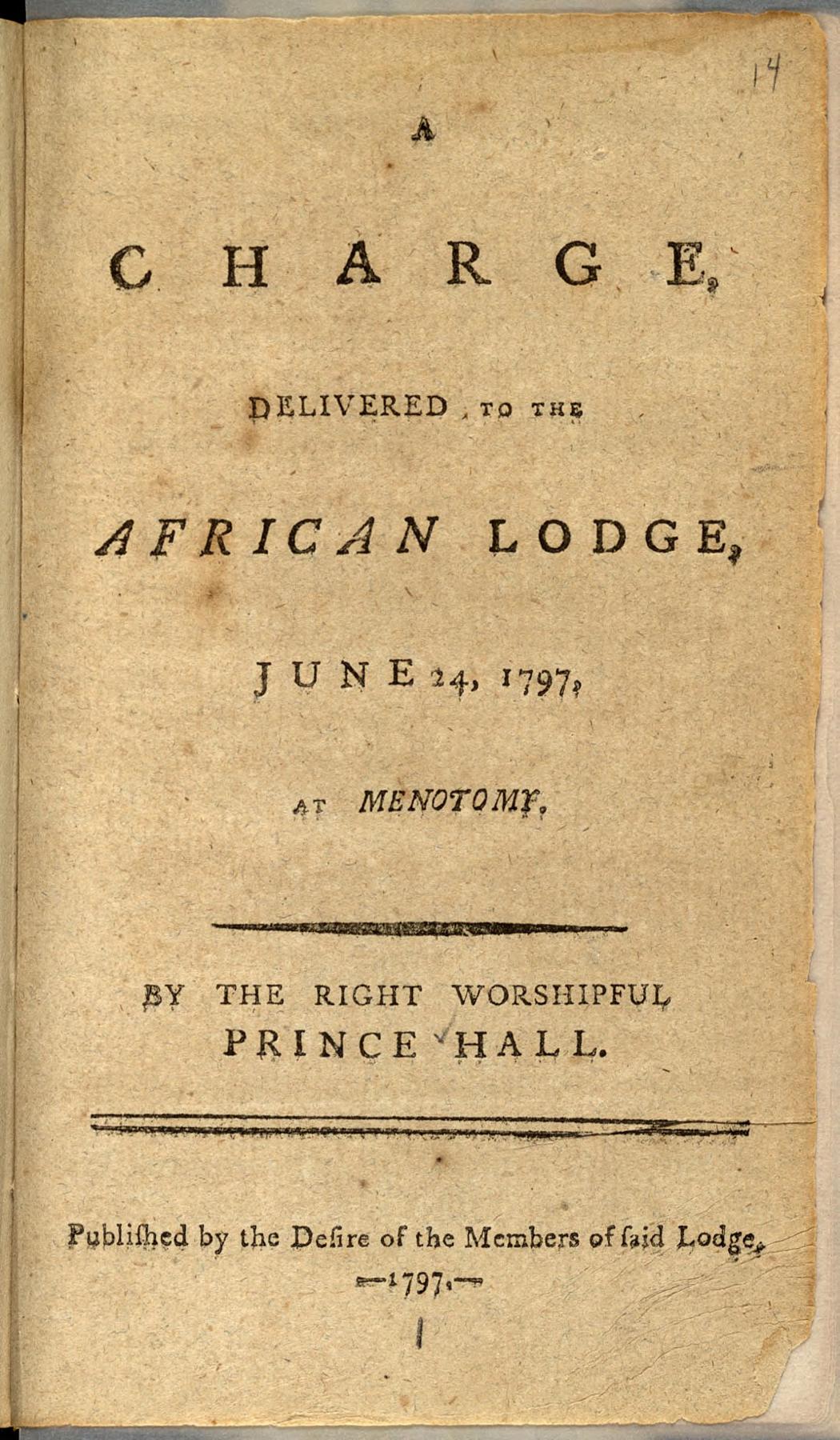
On the 24th of June, 1797, Prince Hall stood before his lodge at Menotomy and did not pretend the town was kind. He named “the daily insults you meet with in the streets of Boston.” Then he told his brethren how to carry themselves:
“Live and act as Masons, that you may die as Masons; let those despisers see, altho’ many of us cannot read, yet by our searches and researches into men and things, we have supplied that defect, and if they will let us we shall call ourselves a charter’d lodge, of just and lawful Masons.”
The condition sits in the middle of that sentence: if they will let us. By then the charter had been in his lodge’s hands since 1787, and the insults were still coming in the street. He answered with the record anyway, in the paper’s own terms: a charter’d lodge of just and lawful Masons.
In 1792 he had said it in one line: “he that despises a black man for the sake of his colour, reproacheth his Maker.” And he had reminded his lodge of the war, when “they marched shoulder to shoulder, brother soldier and brother soldier, to the field of battle.”
What the list says now
England’s own register of every lodge it warranted lists African Lodge under the warrant of 29 September 1784, notes a last payment in 1797, and records the rest in three words: “Erased in 1813.”
The United Grand Lodge of England keeps a public list today of the Grand Lodges it recognizes in the United States.
Massachusetts is on it twice. One entry for the Grand Lodge of Massachusetts. A separate entry, standing on its own line, for the Prince Hall Grand Lodge of Massachusetts. In most states a Prince Hall Grand Lodge sits on that list beside the other one. Not in all of them. For Mississippi, Louisiana, Arkansas, South Carolina, Kentucky and West Virginia, among others, England lists a Grand Lodge and no Prince Hall Grand Lodge beside it.
The word clandestine appears nowhere on that list. The Prince Hall Grand Lodge of Massachusetts, which calls African Lodge “Where It All Began,” has a line of its own.
So put the question to the people who used the word. Who checked the white lodges the same way? And if nobody did, why, in Eliot’s telling, was the question put to the men who had the warrant in their hands?
Word Reimagined: CLANDESTINE
The word is CLANDESTINE.
It is meant to describe Masons made without authority, a lodge working outside the law of the Craft.
By February 1795 it had been aimed at a lodge that held a warrant from London, and John Eliot, whose letter the Massachusetts Historical Society holds, wrote down the excuse and, in the same letter, what he believed it covered.
In Eliot’s account, clandestine was what they called you when your warrant had come from London and they still would not sit with you.
We keep the paper. That is the whole job of an archive, and it is the reason this one exists: so the next time somebody reaches for the word, the record is already in front of them.
So when an institution reaches for a word like that, do what Eliot did. Set the word next to the paper and read them both, out loud, in the same breath.
On the table
Where has a paper been refused in your family, whether it was a deed, a discharge, a license or a charter?
Name the paper. Name who would not read it. Name the word they used instead.
If it is anchored, Docket it.
If it is still forming, put it on the table and we sharpen it together.
We are not building a comment section.
We are building the Archive.
Correction
Corrected 2026-09-30. This casefile published on September 19, 2026. Two errors are named here rather than quietly repaired.
The paper was called good, and the warrant’s own condition was left out. The casefile said “The objection never called the paper false,” said the refusal “never called the charter false,” and called the lodge’s paper good in the subtitle and in its closing. Eliot’s letter is one witness’s account, and the reason he records (“made clandestinely, in the first place, which being known would have prevented them from receiving a Charter”) goes to how the charter was obtained. The warrant itself, as Grimshaw reprints it, told Hall “to take special care that all and every one of the said brethren are to have been regularly made Masons.” The casefile quoted the warrant’s dating line from the same reprint and left that condition out. It is now quoted, as Grimshaw reprints it; other printings word the clause differently, and each makes Hall answerable for how the brethren were made. “The objection never called the paper false” now reads “As Eliot records it, the objection did not call the paper forged”; “never called the charter false” now reads “as Eliot records it, did not call the charter forged”; the subtitle’s “whose paper was good” now reads “that held a warrant from London”; and “when your paper was good” now reads “when your warrant had come from London.”
Two universals no source supports. The casefile called Eliot “the one man who wrote the excuse down” and asked why the question was “only ever asked of the men who had the warrant in their hands.” The research behind this casefile holds one contemporary account of the excuse, and its claim is about Eliot’s own town. “the one man who wrote the excuse down also wrote down what it covered” now reads “John Eliot, whose letter the Massachusetts Historical Society holds, wrote down the excuse and, in the same letter, what he believed it covered,” and “why was the question only ever asked of” now reads “why, in Eliot’s telling, was the question put to.”
Smaller changes made at the same time, each quoted as it was and as it now reads:
- “Early thesis.” is cut. It was a draft label left in the published text.
- “and it came from people who did not want to sit beside them” now reads “and Eliot, who wrote it down, did not believe that was the real reason.”
- “In Boston in 1795 it was aimed” now reads “By February 1795 it had been aimed,” the Society’s date for Eliot’s letter.
- The excerpt’s “The white lodges would not acknowledge it, and they had a word ready.” now reads “The white Masons of the town would not acknowledge it, and they gave a reason.” The hook line’s “Boston’s white lodges called them clandestine anyway.” now reads “Boston’s white Masons answered that they had been made clandestinely.” Eliot says it was “white Masons” who would not acknowledge them.
- “He wrote the answer into the same letter, and the answer was shame” now reads “He wrote his own answer into the same letter, and his answer was shame.”
- “it was a question nobody would have put to a white lodge” now reads Eliot’s own words, “this inquiry would not have been made about White Lodges.”
- “So put the question they never had to answer in 1795 to the people who used the word. What was wrong with the paper?” now reads “So put the question to the people who used the word.”
- “England did not hold on to the lodge the first time.” is cut.
- “In that room, clandestine was what they called you” now reads “In Eliot’s account, clandestine was what they called you.”
- “Where has a good paper been refused” now reads “Where has a paper been refused.”
- “for ten years” now reads “since 1787,” and “Five years before that” now reads “In 1792.”
- In the docket, the Eliot, 1792, 1797, Grimshaw and Lane items now carry the exact words the essay quotes from each, and “recognises” now reads “recognizes.”
Sources: Massachusetts Historical Society, Letter from John Eliot to Jeremy Belknap, [February 1795], in the Society’s transcription; William H. Grimshaw, Official History of Freemasonry among the Colored People in North America (1903), pp. 77-78; Prince Hall, charges of June 25, 1792, and June 24, 1797 (Evans / Text Creation Partnership); Lane’s Masonic Records 1717-1894, African Lodge, Boston. Read on September 30, 2026.
DOCKET
- Massachusetts Historical Society. Letter from John Eliot to Jeremy Belknap, [February 1795] — the charter "signed by the Earl of Effingham, and countersigned by the Duke of Cumberland," the passage Eliot calls "still more remarkable," the refusal, the excuse ("made clandestinely, in the first place") and Eliot's verdict. masshist.org · Confidence: A
- Prince Hall. A charge delivered to the brethren of the African Lodge, 25 June 1792 — "In the year 1787 (the year in which we received our charter)"; "And now, my African brethren, you see what a noble order you are members of."; "they marched shoulder to shoulder, brother soldier and brother soldier, to the field of battle"; "he that despises a black man for the sake of his colour, reproacheth his Maker". Evans / TCP · Confidence: A
- Prince Hall. A charge, delivered to the African Lodge, June 24, 1797, at Menotomy — "the daily insults you meet with in the streets of Boston"; "if they will let us we shall call ourselves a charter'd lodge, of just and lawful Masons." Evans / TCP · Confidence: A
- Massachusetts Historical Society. Petition for freedom (manuscript copy), [13] January 1777 — the official copy "has been attributed to Prince Hall" and was signed by Hall and seven other Black men. masshist.org · Confidence: A
- Library of Congress. Prince Hall Freemasonry: A Resource Guide — March 6, 1775, Prince Hall and fourteen other men initiated. loc.gov · Confidence: A
- Prince Hall Grand Lodge of Massachusetts. A Brief History of African Lodge 459 — the Grand Lodge's own account: Lodge No. 441, the permit, the charter of September 29, 1784. princehall.org · Confidence: B
- William H. Grimshaw. Official History of Freemasonry among the Colored People in North America (1903) — reprints the warrant, which requires Hall "to take special care that all and every one of the said brethren are to have been regularly made Masons," and its dating line, "Given at London under our hand and seal of Masonry this 29th day of September, A. L. 5784". archive.org · Confidence: B
- Lane's Masonic Records 1717-1894. African Lodge, Boston — warrant of 29 Sept. 1784; lodge number 459 (1781), 370 (1792); last payment 1797; "Erased in 1813." Museum of Freemasonry · dhi.ac.uk · Confidence: A
- United Grand Lodge of England. Foreign Grand Lodges — recognizes Prince Hall Grand Lodges today as separate entries, in most states but not all. ugle.org.uk · Confidence: A
Cite this file
Word Reimagined, “CLANDESTINE,” WR-FCT-032, https://doi.org/10.5281/zenodo.23069417.
The number is permanent. WR-FCT-032 names this file today and will name the same file in ten years. Add the date you retrieved it.
This file is also deposited with Zenodo, at CERN, under 10.5281/zenodo.23069417. That copy carries the essay whole, its docket and its source ledger, and it outlives this domain.
Trace record
Every claim in this file resolves to a source in the custody ledger.
- Massachusetts Historical Society, Petition for freedom (manuscript copy), [13] January 1777
Massachusetts Historical Society, Collections Online. "Petition for freedom (manuscript copy) to the Massachusetts Council and the House of Representatives, [13] January 1777." Jeremy Belknap papers; 30.7 x 20.5 cm. Catalogue note: the official copy submitted to the legislature (Massachusetts Archives), dated 13 January 1777, "has been attributed to Prince Hall (1735-1807) and was signed by Hall and seven other Black men."
archive A
- Massachusetts Historical Society, Letter from John Eliot to Jeremy Belknap, [February 1795]
Massachusetts Historical Society, Collections Online. "Letter from John Eliot to Jeremy Belknap (on printed circular with queries about slavery in Massachusetts), [February 1795]." Jeremy Belknap papers; 30.0 x 19.0 cm. John Eliot answering St. George Tucker's queries, circulated by Belknap. Quoted from the Society's transcription.
archive A
- Library of Congress, Prince Hall Freemasonry: A Resource Guide
Library of Congress. "Prince Hall Freemasonry: A Resource Guide," Introduction. Dates the initiation of Prince Hall and fourteen other men to March 6, 1775.
web A
- Prince Hall Grand Lodge of Massachusetts, African Lodge 459: "Where It All Began"
Most Worshipful Prince Hall Grand Lodge, Free and Accepted Masons, Jurisdiction of Massachusetts. "A Brief History of African Lodge 459." The Grand Lodge's own account of the 1775 initiation in Lodge No. 441 (Irish registry, 38th Foot), the permit, and the charter of September 29, 1784.
web B
- William H. Grimshaw, Official History of Freemasonry among the Colored People in North America (1903)
William H. Grimshaw. Official History of Freemasonry among the Colored People in North America. 1903. Reprints the warrant's dating line: "Given at London under our hand and seal of Masonry this 29th day of September, A. L. 5784, A. D. 1784." Read at the Internet Archive (officialhistoryo01grim).
book B
- Prince Hall, A charge delivered to the brethren of the African Lodge, 25 June 1792
Prince Hall. A charge delivered to the brethren of the African Lodge on the 25th of June, 1792. At the hall of Brother William Smith, in Charlestown. [Boston]: Printed and sold [by T. & J. Fleet] at the Bible and Heart, Cornhill, Boston, [1792]. Evans Early American Imprint Collection, Text Creation Partnership edition (CC0).
archive A
- Prince Hall, A charge, delivered to the African Lodge, June 24, 1797, at Menotomy
Prince Hall. A charge, delivered to the African Lodge, June 24, 1797, at Menotomy. [Boston]: Printed by Benjamin Edes, 1797. Evans Early American Imprint Collection, Text Creation Partnership edition (CC0).
archive A
- United Grand Lodge of England, Foreign Grand Lodges (recognised Grand Lodges)
United Grand Lodge of England. "Foreign Grand Lodges." The list of Grand Lodges it recognises, including, under the United States of America, the Prince Hall Grand Lodges as separate entries (for Massachusetts: "Grand Lodge of Massachusetts" and "Prince Hall Grand Lodge of Massachusetts").
web A
- Lane's Masonic Records 1717-1894: African Lodge (Boston), record 1301
Lane's Masonic Records 1717-1894, African Lodge, Boston, Massachusetts (record 1301; serial number 1029). Warrant of Constitution: 29 Sept. 1784. Lodge Number (1781): 459; Lodge Number (1792): 370. Erased: Erased in 1813. Notes: Last payment 1797. Museum of Freemasonry, London; published by the Digital Humanities Institute.
archive A
Sources are graded A (primary) / B (secondary academic) / C (secondary journalism) / D (tertiary or contested). See the manifesto’s Evidence Standard for full criteria.
File custody
- File
- CLANDESTINE
- Accession
- WR-FCT-032
- Thread
- Standalone
- Status
- published
- Published
- 2026-09-19
- Last updated
- 2026-09-30