spirituality Filed 09 · 22 12 min WR-FCT-034
CONSENTED
Damon Landor says a guard threw his copy of a court ruling in the trash before his head was shaved. The Supreme Court held that the federal law he invoked gives him no damages claim against the officers, because they never consented to answer one.
For more than three hundred years the law suppressed Black spiritual practice. In 1993 the Court said a city could not do that. In 2026 it held that RLUIPA, the federal law Damon Landor sued under, gives him no damages claim against the officers personally.
Every new file, the day it is filed.
We emphatically condemn the treatment that Landor endured. Still, we remain bound by our prior decision in Sossamon I that, under RLUIPA, he cannot seek money damages from officials in their individual capacities.
Damon Landor carried a court decision into a Louisiana prison. According to his complaint, the guard at intake threw it in the trash.
Everything in this file about what happened to him comes from that complaint, as the courts recited it. The case was dismissed before any of it was tested. At that stage a court takes the complaint’s account as true and asks one question: if all of this happened, does the law give him a remedy? On whether RLUIPA lets him make the officers pay, every court that ruled on it said no.
The vow
Landor is Rastafarian. His faith keeps the Nazarite Vow from the Book of Numbers, to “let the locks of the hair of his head grow.” Judge Oldham of the Fifth Circuit, dissenting with five colleagues from that court’s refusal to rehear the case, wrote that Landor “did not cut his hair for almost two decades,” and that at its longest his hair “fell nearly to his knees.”
By the same account, beginning in August 2020 he “was incarcerated for five months in three different Louisiana state prisons,” in Judge Oldham’s words. The first two accommodated his vow.
He reached the third with about three weeks left to serve.
The paper
He came ready. The Supreme Court’s dissent describes what he brought: “a physical, printed copy” of Ware v. Louisiana Department of Corrections.
Ware was not a stranger’s case. In 2017 the Fifth Circuit, the federal appeals court that covers Louisiana, ruled for a Rastafarian man held by the same department, whose locks had grown past his shoulders. The department, the court found, “failed to satisfy its burden to show the policies are the least restrictive means of serving a compelling interest.” The court reversed and entered judgment for him.
Six years later, a panel of that same court heard Landor’s appeal and told the next part of the story in its own voice: “And, amazingly, Landor also handed the guard a copy of our decision in Ware.”
Then: “Unmoved by our caselaw, the guard threw Landor’s papers in the trash.”
The warden was summoned. By the panel’s account, he “demanded Landor hand over documentation from his sentencing judge that corroborated his religious beliefs.” Landor could not produce it on the spot. Two guards, the panel wrote, “carried him into another room, handcuffed him to a chair, held him down, and shaved his head.”
The right
Whether the shaving broke federal law was never the question the courts decided. The question was whether RLUIPA let him make the officers answer for it.
The law Landor was carrying a piece of is the Religious Land Use and Institutionalized Persons Act of 2000, known as RLUIPA. It protects the religious exercise of people held in prisons that take federal money, and it gives them a way to enforce that protection. Its words: a person may “obtain appropriate relief against a government.” And the statute counts as a government “any other person acting under color of State law.” The dissent reads that to reach “any prison employee who violates the statute.”
The Supreme Court had applied that law to a prisoner’s beard in 2015. The Fifth Circuit had applied it to a Rastafarian’s locks, against the Louisiana Department of Corrections, in 2017. When Landor stood at intake with Ware in his hand, the right was printed on the paper he held.
What the Court asked
Landor sued the department and the officers. By the time the case reached the Supreme Court, what was left was his claim for money damages against the officers themselves, in their personal capacities. The question was whether RLUIPA allows that.
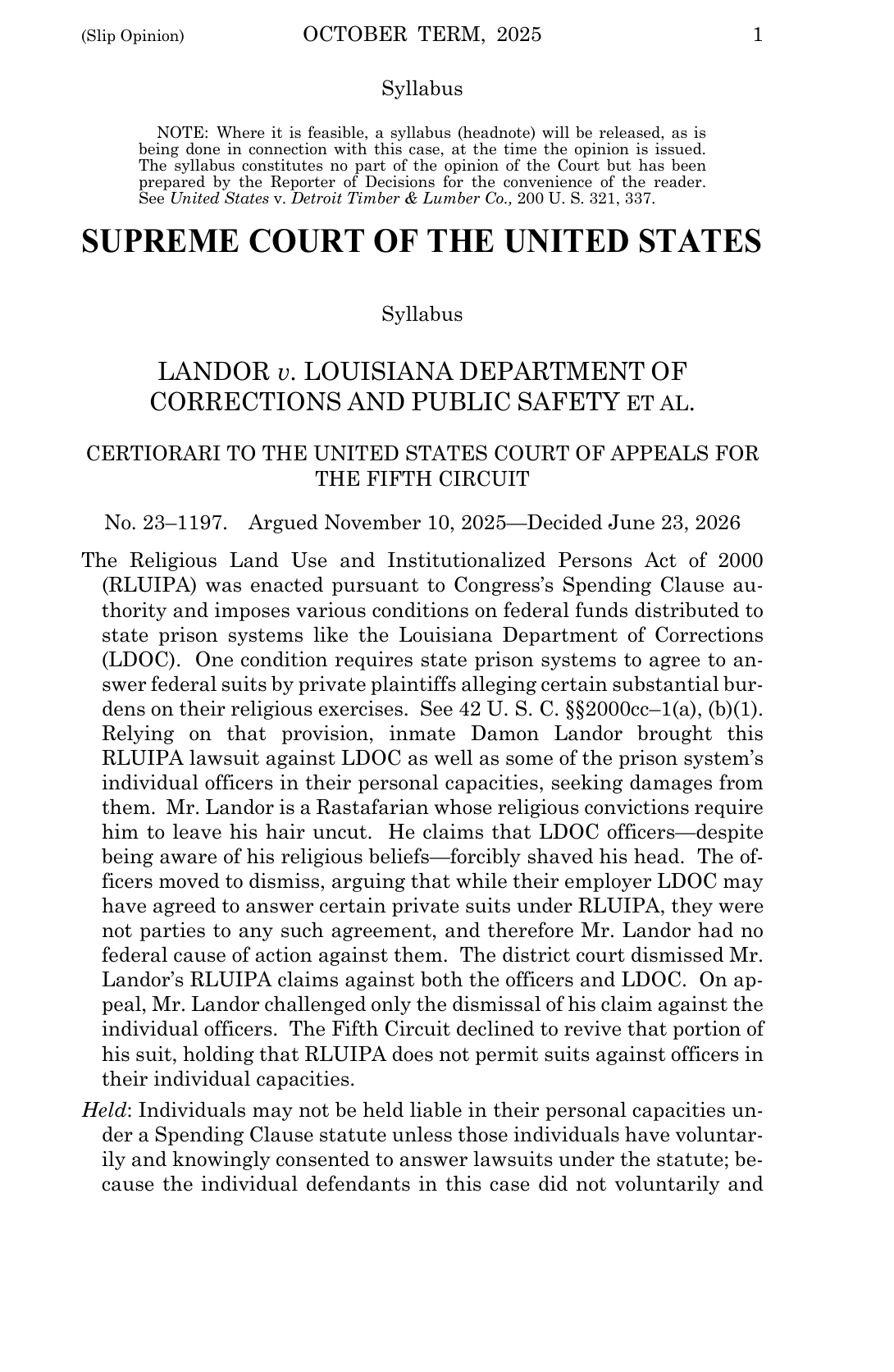
The Court held that it does not. Justice Gorsuch wrote for six justices. The holding, as the syllabus prepared by the Court’s Reporter of Decisions states it: “Individuals may not be held liable in their personal capacities under a Spending Clause statute unless those individuals have voluntarily and knowingly consented to answer lawsuits under the statute.”
The reasoning deserves to be stated the way the majority stated it. RLUIPA rests on the Spending Clause, Congress’s power to attach conditions to federal money. Louisiana took the money, and so Louisiana agreed to the conditions. The officers did not sign anything. In the majority’s words, “Congress’s power to spend money does not include the power to regulate. Spending Clause statutes can bind only those who voluntarily and knowingly undertake obligations by agreement with the federal government.”
The majority’s stated concern was the reach of federal power. If a funding condition could make individual employees personally liable, it warned, “Congress could regulate directly, too, in innumerable spheres, including ones traditionally reserved to the States.”
It also conceded that Congress could have reached the officers another way. The majority wrote that Congress “could have lawfully imposed personal liability on the individual defendants,” for instance by requiring, as a condition of the money, that officers “agree to enter separate contracts with the federal government consenting to answer suits under RLUIPA.” Or, the majority wrote, Congress “might have conditioned its funds on Louisiana’s agreement to exercise its own regulatory powers to adopt a state law cause of action enforceable against LDOC officers who violate RLUIPA.” Congress did neither. So RLUIPA gives him no claim against the officers.
What was left
The question the Court answered was narrow. What it left Landor was narrower.
He could not get an order stopping the violation, because he was already out. His release, the district court held, mooted his request for injunctive relief. The State was closed to him too: the Court held in 2011, in Sossamon v. Texas, that the States keep their immunity from damages under this same law. And now RLUIPA gave him no way to collect from the people who, by his account, held him down.
The Fifth Circuit panel said as much while it ruled against him. “We emphatically condemn the treatment that Landor endured,” Judge Clement wrote. “Still, we remain bound by our prior decision in Sossamon I that, under RLUIPA, he cannot seek money damages from officials in their individual capacities.”
In the Supreme Court, Justice Jackson wrote for three dissenters. When Sossamon took away damages against the States, Justice Sotomayor wrote in dissent that plaintiffs suing state defendants under RLUIPA would be “forced to seek enforcement of those rights with one hand tied behind their backs.” Justice Jackson picked up the image: “Today the Court ties the other hand.” She named what follows. Prisoners like Landor “will often be left remediless,” and the officials who hold them “will have little incentive to abide by federal law, even if it is handed to them on a piece of paper.”
She also marked the two openings that remain. A prisoner held in a local jail, rather than a state prison, may still recover damages from the municipality, and a plaintiff who can reach the part of the law that rests on the Commerce Clause may recover too. Neither describes what happened to Damon Landor. The majority named another, in a footnote: counsel for the officers had indicated that “just such a claim may be available to Mr. Landor under state law in state court.” Whether he has brought one, the record this file read does not say.
The line it ends
This vertical has been following one line for more than three centuries.
In 1685 the Code Noir required that the enslaved in France’s American islands be baptized Catholic, and forbade the public exercise of any other religion. Jamaica wrote Obeah into its slave-control law in 1760, after Tacky’s Revolt, and in 1935 Haiti criminalized what its decree-law called “les pratiques superstitieuses.” The record of them is in WHAT WAS BURIED, NOT BROKEN.
In 1993, in the Hialeah case, the Supreme Court finally refused to let a city do the same thing in quieter words. That file is UNNECESSARY.
Landor is not another link of that kind. No opinion in this case points to a statute that forbade his faith. A department grooming policy did, and in Ware the Fifth Circuit had already held that policy unlawful as applied to another Rastafarian man. The law protected him, the court that covers Louisiana had said so in plain terms, and he had the ruling in his hand.
The protection survives on paper. The federal damages remedy against the officers does not.
On the table
The opinion turns on one word. It asks whether the officers had voluntarily and knowingly consented to be sued, and it finds they had not. The record’s account of what Damon Landor consented to is shorter: two guards carried him into another room.
For more than three hundred years the law suppressed the practice. The newer method needs no statute against the faith. It leaves the right standing in the statute books and takes away the federal damages remedy that would make an official think twice before throwing it in the trash.
The right is still the law. A person held in a state prison may still ask a court, while they are inside, to order the prison to honor it, though a transfer or a release can moot the request. And the majority wrote down, in its own words, one of two ways Congress could put the rest back: a condition that officers “agree to enter separate contracts with the federal government consenting to answer suits under RLUIPA.”
Correction
Corrected 2026-09-30. This essay published on September 22, 2026. A reading of the whole casefile against its primaries found five errors, named here rather than quietly repaired. The account of what happened to Damon Landor stands. Most of what changed is how far the casefile said the holding reaches.
The holding was stated wider than the Court stated it. The subtitle said the officers “cannot be made to pay for it,” the excerpt said the people they violated “cannot make them pay,” and the hook line and the closing line ended “The remedy does not.” What the Court held is narrower: “Mr. Landor does not have a federal RLUIPA cause of action against the officers.” Each of those lines is now limited to what RLUIPA gives him against the officers personally.
A remedy the majority named was left out. The majority’s footnote 4 says that “counsel for the individual officers before us indicated that just such a claim may be available to Mr. Landor under state law in state court.” The casefile did not mention it and said “the officers owe nothing.” The section headed What was left now quotes the footnote, and says that the record this file read does not show whether he has brought such a claim.
A quotation carried another justice’s wording. The casefile said Justice Sotomayor had written that Sossamon left prisoners “to seek enforcement of [their] rights with one hand tied behind their backs.” The bracket is Justice Jackson’s alteration, made when she quoted it in Landor; in Justice Sotomayor’s sentence the subject of that clause is “plaintiffs suing state defendants under RLUIPA.” The passage now quotes her Sossamon dissent directly.
A sentence length that no document gives. The casefile said Landor “began a five-month sentence.” Judge Oldham’s dissent from the denial of rehearing says he “was incarcerated for five months in three different Louisiana state prisons”; no opinion this casefile read states the length of the sentence.
“No law in this case forbade anything.” A department rule did. The majority records Landor’s fear that officers “might cut his hair pursuant to standard LDOC grooming policies,” and Ware says those policies “prohibit inmates housed in a Department of Corrections prison from having dreadlocks.” The sentence now says that no opinion in this case points to a statute that forbade his faith, that a grooming policy did, and that the Fifth Circuit had already held the policy unlawful as applied to Christopher Ware.
Smaller changes made at the same time, each quoted as it was and as it now reads:
- “his copy of the law in the trash” now reads “his copy of a court ruling in the trash,” and “because they never consented to be” now reads “because they never consented to answer one,” in the subtitle.
- “he was held for five months in three Louisiana state prisons” now quotes Judge Oldham, “was incarcerated for five months in three different Louisiana state prisons.”
- “The question was who could be made to answer for it.” now reads “The question was whether RLUIPA let him make the officers answer for it.”
- “The holding, in the Court’s syllabus:” now reads “The holding, as the syllabus prepared by the Court’s Reporter of Decisions states it:” In the image description, “running through the Court’s holding” now reads “running through the syllabus’s statement of the holding.” The docket now says the syllabus is no part of the opinion, and adds the opinion’s own sentence and its footnote 4.
- The Fifth Circuit’s sentence that begins “Still, we remain bound by our prior decision” is now quoted to its end, “in Sossamon I that, under RLUIPA, he cannot seek money damages from officials in their individual capacities,” in the pull quote, the docket and the body.
- “On the question of making the officers pay, every court that ruled on his case said no.” now reads “On whether RLUIPA lets him make the officers pay, every court that ruled on it said no.”
- “And now he could not collect from the people who, by his account, held him down.” now reads “And now RLUIPA gave him no way to collect from the people who, by his account, held him down.”
- “the enslaved in France’s colonies” now reads “the enslaved in France’s American islands,” the reach of the 1685 edict.
- “The newer method forbids nothing.” now reads “The newer method needs no statute against the faith.”
- “takes away the one thing that would make an official think twice” now reads “takes away the federal damages remedy that would make an official think twice.”
- “can still ask a court” now reads “may still ask a court,” and the sentence now adds that a transfer or a release can moot the request.
- “what Congress would have to pass to put the rest back” now reads “one of two ways Congress could put the rest back,” and the body now quotes the majority’s second way.
- The Sources line adds Justice Sotomayor’s dissent in Sossamon v. Texas.
Sources: Landor v. Louisiana Dept. of Corrections and Public Safety, No. 23-1197 (U.S. June 23, 2026), slip opinion, including Jackson, J., dissenting. Landor v. Louisiana Dept. of Corrections and Public Safety, 82 F.4th 337 (5th Cir. 2023), and the order denying rehearing en banc, 93 F.4th 259 (5th Cir. 2024). Ware v. Louisiana Dept. of Corrections, 866 F.3d 263 (5th Cir. 2017). 42 U.S.C. §§2000cc-2(a), 2000cc-5(4)(A). Each read in full on September 22, 2026. Sossamon v. Texas, 563 U.S. 277 (2011), Sotomayor, J., dissenting, read on September 30, 2026.
What the law left
Cite this file
Word Reimagined, “CONSENTED,” WR-FCT-034, https://doi.org/10.5281/zenodo.23069422.
The number is permanent. WR-FCT-034 names this file today and will name the same file in ten years. Add the date you retrieved it.
This file is also deposited with Zenodo, at CERN, under 10.5281/zenodo.23069422. That copy carries the essay whole, its docket and its source ledger, and it outlives this domain.
Trace record
Every claim in this file resolves to a source in the custody ledger.
- Landor v. Louisiana Department of Corrections and Public Safety, No. 23-1197 (U.S. June 23, 2026), slip opinion
Landor v. Louisiana Dept. of Corrections and Public Safety, No. 23-1197, 609 U.S. ___ (June 23, 2026). Gorsuch, J., for the Court (Roberts, C.J., Thomas, Alito, Kavanaugh, Barrett, JJ.); Jackson, J., dissenting, joined by Sotomayor and Kagan, JJ. Held: individuals may not be held liable in their personal capacities under a Spending Clause statute unless they have voluntarily and knowingly consented to answer lawsuits under it.
archive A
- Landor v. Louisiana Department of Corrections and Public Safety, No. 22-30686 (5th Cir. Sept. 14, 2023), 82 F.4th 337
Landor v. Louisiana Dept. of Corrections and Public Safety, 82 F.4th 337 (5th Cir. 2023), Clement, J., for a panel of Clement, Graves and Higginson, JJ. Recites the complaint's account (the guard threw Landor's copy of Ware in the trash; guards handcuffed him to a chair and shaved his head), 'emphatically condemn[s]' the treatment, and affirms on circuit precedent that RLUIPA allows no individual-capacity damages.
archive A
- Landor v. Louisiana Department of Corrections and Public Safety, No. 22-30686 (5th Cir. Feb. 5, 2024), rehearing en banc denied, 93 F.4th 259
Landor v. Louisiana Dept. of Corrections and Public Safety, 93 F.4th 259 (5th Cir. 2024), denying rehearing en banc; Oldham, J., joined by Smith, Elrod, Willett, Ho and Duncan, JJ., dissenting from the denial. The dissent states that Landor did not cut his hair for almost two decades, that his locks fell nearly to his knees, and that the first two of three Louisiana prisons accommodated him.
archive A
- Ware v. Louisiana Department of Corrections, No. 16-31012 (5th Cir. 2017), 866 F.3d 263
Ware v. Louisiana Dept. of Corrections, 866 F.3d 263 (5th Cir. 2017) (filed July 28, revised Aug. 17, 2017). Holds under RLUIPA for Christopher Ware, a Rastafarian man in the Department's custody: the Department failed to show its grooming policies were the least restrictive means of serving a compelling interest; judgment reversed and rendered for Ware.
archive A
- Religious Land Use and Institutionalized Persons Act of 2000, 42 U.S.C. §2000cc-2(a) and §2000cc-5(4)(A)
42 U.S.C. §2000cc-2(a): 'A person may assert a violation of this chapter as a claim or defense in a judicial proceeding and obtain appropriate relief against a government.' §2000cc-5(4)(A) defines 'government' to include 'any other person acting under color of State law.'
web B
- Holt v. Hobbs, 574 U.S. 352 (2015)
Holt v. Hobbs, 574 U.S. 352 (2015), decided January 20, 2015. Held: 'The Department's grooming policy violates RLUIPA insofar as it prevents petitioner from growing a ½-inch beard in accordance with his religious beliefs.'
archive A
- Sossamon v. Texas, 563 U.S. 277 (2011)
Sossamon v. Texas, 563 U.S. 277 (2011), decided April 20, 2011. Held: 'States, in accepting federal funding, do not consent to waive their sovereign immunity to private suits for money damages under RLUIPA.'
archive A
- Church of the Lukumi Babalu Aye, Inc. v. City of Hialeah, 508 U.S. 520 (1993)
Church of the Lukumi Babalu Aye, Inc. v. City of Hialeah, 508 U.S. 520 (1993). Opinion of the Court by Kennedy, J. Decided June 11, 1993. Judgment reversed, no dissent. Invalidating Hialeah Ordinances 87-40, 87-52, 87-71 and 87-72 as violations of the Free Exercise Clause. Quoted from the bound United States Reports, volume 508 (Library of Congress scan).
archive A
- Code Noir (1685), Articles 2 and 3
Édit du roi touchant la police des îles de l'Amérique française (the Code Noir), March 1685. Article 2: all enslaved people in the islands shall be baptized and instructed in the Catholic religion. Article 3: the public exercise of any religion other than Catholicism is forbidden, and assemblies held for that purpose are declared unlawful and seditious.
archive A
- Jamaica, Act of 1760, Clause X (the Obeah clause)
An Act to remedy the Evils arising from irregular Assemblies of Slaves (Jamaica, 1760), Clause X. Recital: Obeah men and women 'pretending to have Communication with the Devil and other evil Spirits, whereby the weak and superstitious are deluded.' Enacting clause: possession of 'Blood, Feathers, Parrots Beaks, Dogs Teeth, Alligators Teeth, broken Bottles, Grave Dirt, Rum, Egg-shells,' proved before two magistrates and three freeholders, punishable by 'Death or Transportation.' The National Archives, UK, CO 139/21.
archive A
- Haiti, Décret-loi du 5 septembre 1935 sur les pratiques superstitieuses
Décret-loi du 5 septembre 1935 sur les pratiques superstitieuses, government of President Sténio Vincent. Defines the offence primarily as the ceremonies, rites, dances and meetings in the course of which are practiced, in offering to so-called divinities, sacrifices of cattle or fowl. Bulletin des lois et actes, 1934-35 (Port-au-Prince: Imprimerie de l'État, 1935), p. 351.
archive A
Sources are graded A (primary) / B (secondary academic) / C (secondary journalism) / D (tertiary or contested). See the manifesto’s Evidence Standard for full criteria.
File custody
- File
- CONSENTED
- Accession
- WR-FCT-034
- Thread
- Standalone
- Status
- published
- Published
- 2026-09-22
- Last updated
- 2026-09-30